Blood Boa TRUTH BOMB
For YEARS people called Blood “recessive.”
Reality check → it’s incomplete-dominant (co-dom).
1 copy = visual Blood
2 copies = Super Blood
Blood × Normal = 50% Bloods (not 0 visuals!)
Let’s stop passing myths to new keepers and show the real genetics. For decades, the Blood gene in boas has been mislabeled as “recessive.” That’s outdated and keeping that myth alive only hurts the hobby. Some breeders kept it quiet to protect market value. Morph calculators & care sheets copied the mistake. But the data doesn’t lie. Co-dom is co-dom. Period. We’re done letting outdated info set the tone. The reptile community deserves clarity, proof, and transparency. Blood boas are incomplete-dominant. Always have been. Always will be.
Transparency >>>> Hype
Education >>>> Misinformation
Let’s raise the bar for the hobby !!
This upcoming season, I’ll be sharing full pairing records: Sire/Dam IDs & genetics, Birth outcomes with pics, and Ratio breakdowns. So that there’s no doubt about what Blood really is.
Interesting. I know there is a growing number of ppl that work with leopard that have come to the same conclusion. I agree with that determination seeing as how animals carrying only one copy of the leopard gene express visual traits. However, with the super/heterozygous form of both Blood and Leopard being the desired outcome, I don’t really see how it changes a whole lot other than terminology used in the hobby.
While I’m not a breeder and therefore don’t “work with” leopard, I noticed as soon as I started browsing leopard boas on MM that het leopards had a definite look to their color and especially their pattern that made them unique. I was vaguely confused when I saw it was considered a recessive trait, because it looked to me like one copy of the leopard gene did in fact alter their appearance. Good to hear I’m not crazy and that people way smarter than me have noticed the same thing.
Interesting that something similar may be going on with blood.
Well… this says the data doesnt lie, yet provides 0 data lol
Most bloods are mixed with Nic or Ca, of course they are going to look different from boa to boa. It can take decades to breed those nic and ca traits out. Go on MorphMarket however and youll find tons of het bloods that dont have any identifying traits.
This post is silly to me. Id drop the “Data” if im going to drop a “bomb shell”. Otherwise its all 100% opinion.
This is a Blood x Blood pairing. If Blood x Blood produces Supers, that alone proves that Blood is incomplete-dominant (co-dom). Recessive traits don’t have “super” forms. You either see it or you don’t. Co-dom traits do have super forms because one copy (heterozygous) looks different from two copies (homozygous). So….
1 copy (Bb) = Blood
2 copies (BB) = Super Blood
That’s the textbook co-dominant inheritance pattern. There’s your data…
The data has been saying the same thing since the 90s. Ron St. Pierre proved Blood was a single gene trait decades ago. Blood x Normal = visuals. Blood x Blood = Super Bloods. You don’t get supers from a recessive, that’s Genetics 101. Blaming the variation on Nic or CA influence is like blaming the weather for Punnett squares. Sure, localities change the look, but they don’t rewrite the consistent 25/50/25 ratios or the predictable super form. That’s genetic expression, not just selective locality variance. The ratios still hit, the visuals still show, and the supers still speak for themselves. That’s genetic expression, not just selective locality variance.The only reason people still call it recessive is because that label got stuck back when everyone was still figuring out what a co-dom even was. The breeding records are there Cutting Edge, Legacy, Boa Republic all the same story, every time. So yeah, the data doesn’t lie. But maybe some people just haven’t learned how to read it.
blood x blood only makes bloods just like albino x albino only makes albino. There are no visuals from a blood x normal pairing. Twice youve written that they are incomplete and complete dominant, im confused why we are talking about genetics if we dont understand the basic difference between incomplete dominance and co-dominance …thats actually genetics 101
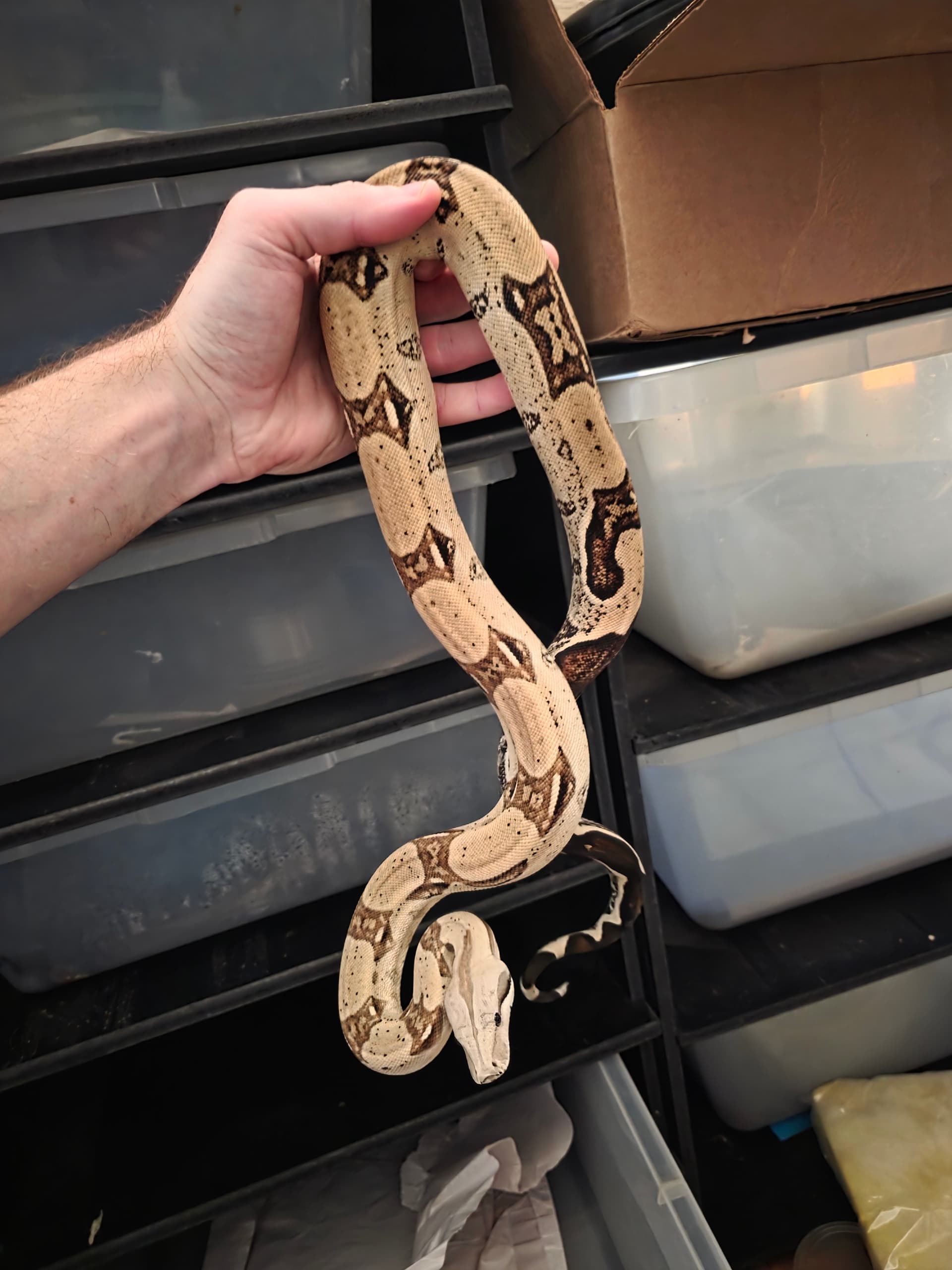
Heres an example, what makes this het blood a visual codom trait? A motley looks like a motley. Fire, fire so on and so forth. How would this identify as blood?
You are preaching concepts of genetics as absolutes while completely mangling the actual realities of genetics. I would gently suggest that you brush up on your understanding of genetics
Matt, you’re mixing up definitions while trying to correct genetics. Co-dom and incomplete dominance are two sides of the same coin. One describes visual expression, the other the underlying inheritance. If a single gene consistently produces a visible intermediate phenotype and a stronger homozygous form, that’s incomplete dominance. Bloods do exactly that. You pair Blood x Normal, you get visual offspring. You pair Blood × Blood, you get Super Bloods. Supers aren’t a recessive trait that’s not a debate, that’s the math. The whole “there are no visuals from Blood x Normal” line doesn’t hold up. Anyone who’s actually bred Bloods knows that the heterozygotes are visually distinct. You can deny the terminology, but you can’t deny the phenotype. This isn’t a “Genetics 101” issue. It’s a “reading comprehension 101” issue.
Actually, this litter does the opposite of proving recessive If Blood were recessive a Blood x Blood pairing would only produce visuals if both parents were homozygous (which would mean all offspring are visual). But here you can clearly see visual variation in expression not a uniform clutch of identical animals. Some have deeper saturation and reduced saddles (typical “Super Blood” indicators), and others show moderate red wash typical of single-gene Bloods. A true recessive gene wouldn’t create any phenotype in heterozygotes. Yet single gene Bloods are visually distinct. You can pick them out from normals every time, even in mixed lineages. That’s the definition of incomplete dominance. The St. Pierre line’s consistency over decades 25/50/25 ratios, visual hets, and supers all back that up. You can reference Cutting Edge, Legacy, or Burke’s early pairing notes and see the same genetic behavior replicated again and again. The data’s there. It’s just a matter of understanding what you’re looking at.
Normals have crisp, defined saddle edges. Het Bloods show fading along those borders, especially mid-body. Note the pattern reduction / alignment drift. Blood influence even in a single copy tends to cause mild pattern inconsistency. Reduced or stretched saddles mid-body. Slightly offset or incomplete “keyhole” shapes. Tails that have fewer, larger blotches than a typical BCI. Head tends to be more triangular and high peaked with cleaner contrast along the crown. Some het Bloods even show a faint masking pattern on the head similar to visuals but more subtle.
Agreed…that data @theboogeyman shared doesn’t give clear or compelling evidence. A visual recessive bred to a visual recessive of the same morph would make only visuals….that is just truth.
If @theboogeyman is talking about how there is viable variation between the young that would be not evidence of it being a Co-dom, but rather evidence of differences in expression.
The way you could prove your argument @theboogeyman would be to breed a blood boa to a 100% wild type and then taking a blood boa (if you even get one) from those neonates and breeding it to another normal…and if you got blood boa from that pairing then you would prove your point. And then do it a couple of times, and you got it….that would prove your argument.
Incomplete dominant and co-dominant are two entirely different things and are about as related to one another as apples are to bananas, the prior both fall under the umbrella of “genetics” the same way the latter both fall under the umbrella of “fruit”, but that is where the association ends
.
.
.
You keep making this ridiculous assertion but have no comprehension what you are actually saying
The term “super” is a wholly illegitimate one when it comes to science. it hold zero relevance or bearing in any real discussion of genetics
“Super” is nothing ore than a hobby slang term for “homozygous”
Let that sink in for a minute or three and then reflect back on your assertion. What you are actually claiming is that recessives do not have a visual homozygous, which is so patently and obviously false. BOTH recessive and incomplete dominant have a homozygous phenotype that is visually distinct
.
.
.
Riley is mostly spot on here. I would only correct that it is not just simple difference in expression of the mutation, it is the very simple fact of genetic variation between any animals - homozygous for one single genetic trait does not mean homozygous for ALL traits
Claiming that the babies from Blood x Blood cannot show variability is as reductive as claiming that, because two people had blue eyes, all of their children would look exactly the same as one another - same height, same stature, same freckles, same ear/nose/facial structure, same hair growth pattern, same finger/toe length…
That’s exactly what the plan is! I have already purchased a wild caught, I have a proven breeder blood and I’ve already posted the pairing plans . The theory will be proven out one way or another. If i’m wrong, i’m, wrong and I’ll admit I’m an ass on all my community profiles .
Like I’ve posted previously I’ll be pairing a wild caught x blood this upcoming season… I’ll take the offspring and pair again from there. I’ll prove it out one way or another. I’m posting updates as well online so everyone should definitely follow along. If my theory is wrong then I’ll admit I’m a donkey and know nothing. But……… I have a very strong feeling I’m not. I’m not here to go back and forth regarding genetics. I just wanted to put out there what I’ve been noticing. Love everyone’s enthusiasm here in this chat! It’s refreshing to know that there still are competent people on earth still .


 This upcoming season, I’ll be sharing full pairing records: Sire/Dam IDs & genetics, Birth outcomes with pics, and Ratio breakdowns. So that there’s no doubt about what Blood really is.
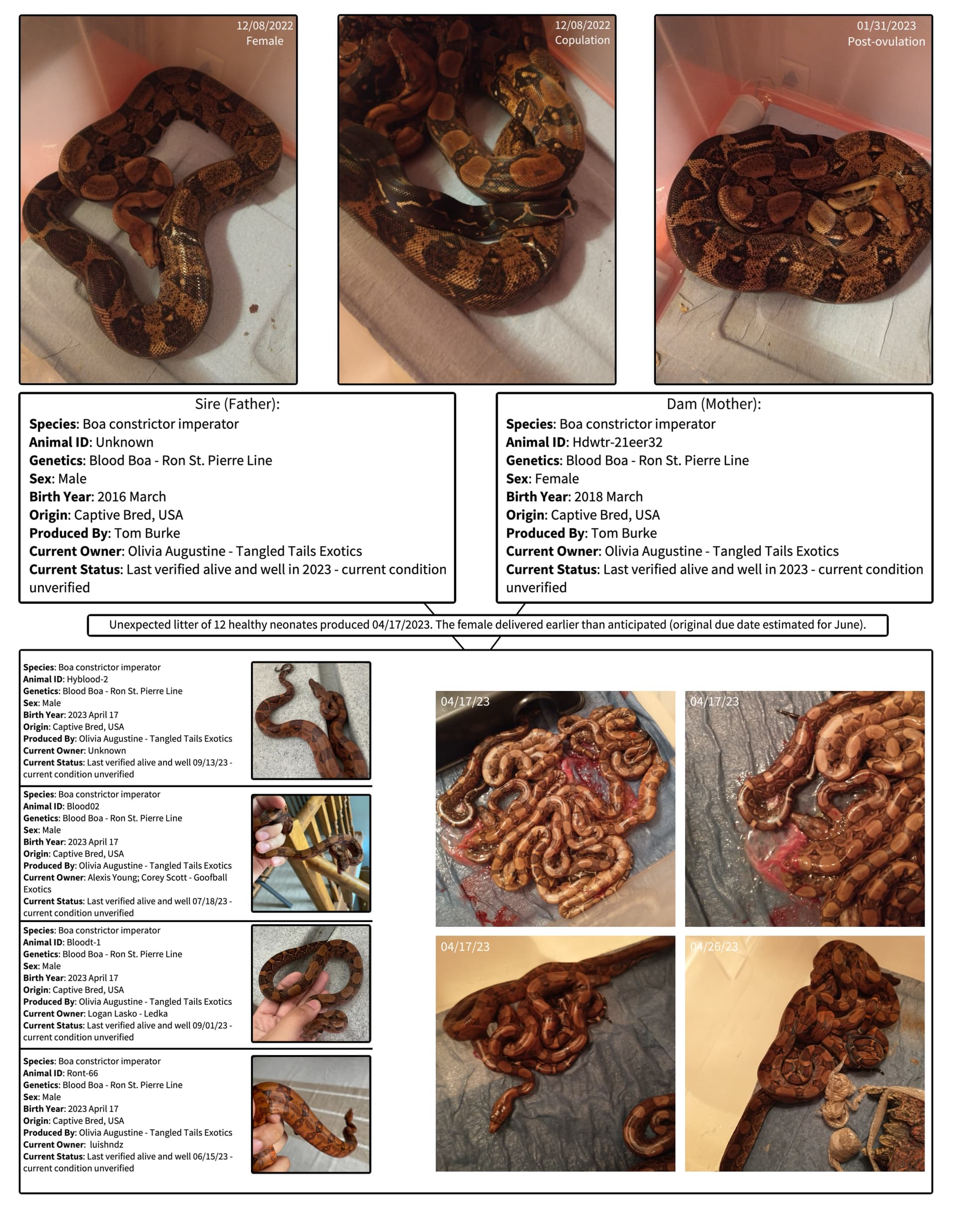
 If Blood were recessive a Blood x Blood pairing would only produce visuals if both parents were homozygous (which would mean all offspring are visual). But here you can clearly see visual variation in expression not a uniform clutch of identical animals. Some have deeper saturation and reduced saddles (typical “Super Blood” indicators), and others show moderate red wash typical of single-gene Bloods. A true recessive gene wouldn’t create any phenotype in heterozygotes. Yet single gene Bloods are visually distinct. You can pick them out from normals every time, even in mixed lineages. That’s the definition of incomplete dominance. The St. Pierre line’s consistency over decades 25/50/25 ratios, visual hets, and supers all back that up. You can reference Cutting Edge, Legacy, or Burke’s early pairing notes and see the same genetic behavior replicated again and again. The data’s there. It’s just a matter of understanding what you’re looking at.
 . The theory will be proven out one way or another. If i’m wrong, i’m, wrong and I’ll admit I’m an ass on all my community profiles
  .
.