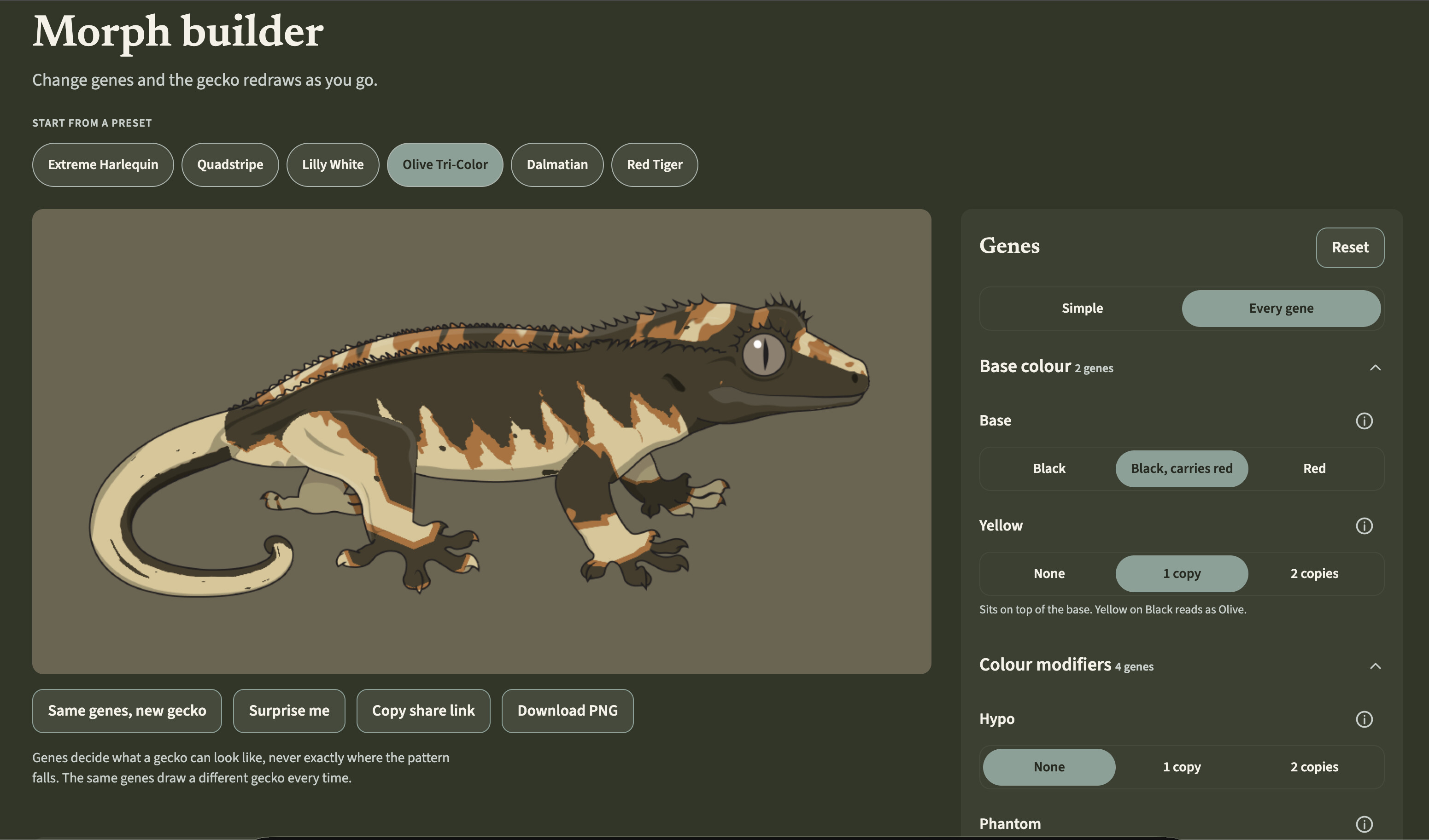
First of all, I like the idea!  However, playing around with it, and reading the notes, it seems like it doesn’t really work like “real” genetics?
I think first off, it’s important to say that crested gecko genetics are not currently mapped, so while there’s a general idea of how they work, nothing is known for certain. There are actually several different overall theories that do not necessarily agree fully. Taking a quick look at Reptidex, it seems like they’re generally following the most widely accepted one, overall based on the stuff from ACReptiles and LMReptiles, but even on there, there are some things that don’t make sense.
So overall, a few things i noticed;
Your guide seems unable to create a yellow-base? It says that black + yellow creates olive, but olive is as of yet not fully understood. Reptidex does say that that combo should create it, however it’s not confirmed afaik. It also states that black is a fixed dominant, but that olive comes from het black het yellow. That wouldn’t be possible if black is fixed. Also, olive x olive pairs should be able to produce yellows, which is not the case from what ive seen, and yellow x black should produce at least some olives, which also usually is not the case. I personally have a few green geckos that came from a red/dark pairing, no yellows have ever popped out from either gecko.
Obviously lots of different ideas of what olive is, so main point is, it’s not fully understood yet, however yellow-base is generally considered dominant, and a gecko that carries it, shows it.
One thing that is pretty commonly accepted though, is that the three base colours (dark, red, yellow) are not allelic, and that they do layer somewhat, so B/r is not possible. Red x red can throw blacks, if red is reccessive and allelic with black that would be impossible. Red is not fully understood, but black bases and yellow bases can throw reds without showing it fully visually, so generally it’s considered recessive, but with a few quirks 
Overall, i don’t think it realistically would be possible to take the possible colour outcomes into account in an online tool like that, so maybe just make it a footnote, and only use the main colours + combos (ie orange if red + yellow, or lavender if black + hypo)?
Phantom removes/reduces pattern, and actually usually darkens the gecko, rather than lightens it, especially on the dorsal. Depending on what type of pattern is also present, and how much it’s been selectively bred, certain types of white-coloured pattern can show through still. Bicolour is usually the opposite of what you describe in your guide, when there’s no pattern on the laterals, but still some on the dorsal. Only lilly whites, whitewalls and very selectively bred lines of porthole/harlequin phantoms are throwing phantoms with lateral pattern. A lot of phantoms show dark tigering, from my understanding this is also due to the overall darkening effect of the trait.
Patternless is generally not believed to be an actual trait, but rather a form of phantom with very little tigering, and no selectively bred pattern expression. In your guide, under the phantom note, you write that "Rule 1: Any bi-color or patternless animal has Phantom. " but under the patternless note you write “It is different from Phantom, which blends colour but can keep pattern.”.
As for pinstripe, it is not cream along the rows of pins, but rather the rows of pins themselves. it is believed to align pattern more horizontally, like the opposite of tiger. In animals with strong pinning, you often get much more blocky pattern, rather than the up/down pattern in animals without pinning and/or strong tigering. In your visual guide, the one without pinstripe is still showing pinstripe, and the one with a full pinstripe, is showing what appears to be broken/partial pins. In your note it is first listed as inc-dom, but then later as “It is plain dominant: one copy draws the whole rows.”
From my understanding, whiteout (the single copy expression of whitewall) mainly shows in the middle of the lateral, it’s when it’s in the homozygous state that it turns into a wall, and connects with the belly. Check out ACReptile’s page on it.
Lilly White does not whiten the whole gecko, it’s just creates a group of raised/thickened scales on the laterals and pinstripe. Sometimes the pattern is barely there, and sometimes it isn’t even white, i have one with neon yellow pattern and one with bright orange pattern. And not all have the yellow/white bellies either, though pretty much all do have some lightening of the bellies in two distinct areas, even though the intensity and size can vary. The only thing all have in common are the raised scales. A lot of the super covered animals are actually covered in snowflake, there are a few korean breeders that have made very high expression animals where it’s obvious that it’s the actual lw-trait and now just snowflake.
Flame and harlequin are the same, flame is when there’s little to no pattern on the laterals and sides, harlequin is when there’s a moderate amount, extreme is when there’s a lot. There’s also banded harlequin, which is when the pattern saddles on to the dorsal. Some people call these XXX however XXX is a line specific to Pangea. Harlequin is generally considered a visual description, not a genetic trait, the genetic part of it being orange pattern and white pattern. From what ive noticed myself, orange pattern seems to be fixed, however some lines are visually almost white. I could be wrong though, as i haven’t worked much with the high white harlequin lines.
These were just the things i noticed, and most everything regarding the genetics is based on the LMReptiles’ foundation genetics page.
Overall i really like the idea, and this is all meant as constructive criticism!  Making a visual guide like this is virtually impossible, so kudos for trying.