I’m a new ball python owner, but I’ve been researching herpetology basically my whole life. I bought my baby from Pets Supplies Plus, with a box of mice pinkies. It’s been less than a week, she’s stopped glass surfing. I have 2 questions.
•HOW ON EARTH do you guys keep your enclosure humidity up? I have a bioactive for her.
•when should I feed her?
Edit:
Here’s the enclosure, I’ll go buy rat pups. I have added a large stick thing in the middle of the enclosure since I took that photo. I’ve had to take her out a couple times due to the enclosure getting too hot or too cold, she just chills on my neck or around my wrist. The humidity gets down into the 30s if I don’t mist the enclosure every 40 minutes. I have a screen lid, the hot side is on the left and it typically stays around 80. For some reason, the cool side stays much more humid. Perhaps it’s because of her heat lamp.
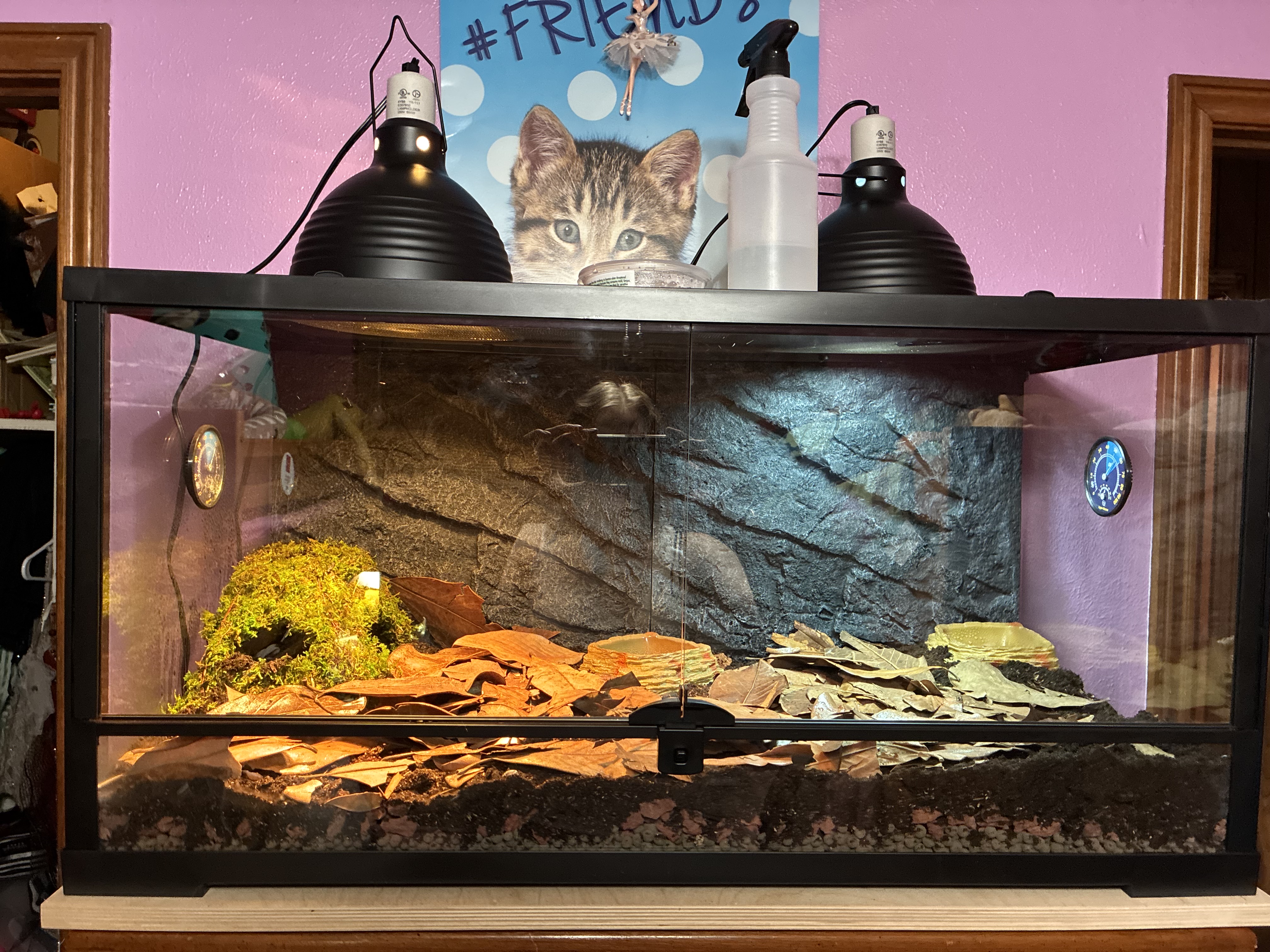
Pictures are worth a thousand words! Hard to tell you where you’re losing humidity without seeing the setup, so if you can supply an image of it and tell us your parameters (ambient temp, hot spot, etc) it would significantly help us help you.
Congrats on your new snake, of course! I usually give the newbies a few days to a week to settle without any handling before trying to feed, and only will actively start to handle after they’ve taken 2 meals consecutively.
I will chime in and add that mouse pinkies are way too small even for a fresh hatchling Ball Python.
Depending on your snake’s weight they most likely need to start at least pup rats, a general basis to start is feeding 10% body weight every 10 days and adjust as needed for your snake.
Get started by getting your snake’s weight in grams and figuring out what prey size you need based on that.
Humidity should stay around 65%, temps need to be 86°F on the warm end and 72-75°F on the cool end.
Feeding should begin at 5 days minimum after recieving your snake, do not be discouraged if they do not eat right away- they may need more time. Offer every 5-7 days until they accept a meal.
Having a look at what the enclosure is like will help a ton in discerning anything we can help with 
If you’re going with frozen big box store rodents they probably won’t have the sizes we refer to as ‘pup rat’ or ‘hopper mice’ which is usually what ball pythons start on. You would want to get ‘small mice’.
A common misconception you can hear at big box pet shops is that reptiles can only safely swallow prey items the size of ‘the space between their eyes’. While this is generally the case for smaller lizards, frogs and geckos this isn’t the case for a ball python.
As mentioned by Christina, a great guideline is 10% of the body weight or you can find something the same width as the body of the BP. They’re stretchy little guys who aren’t afraid of looking like they have a ‘food baby’
Thank you!!!
Cover up most of the screen top to help with humidity. Heat-resistant foil tape (often sold as HVAC tape) is probably the quickest and cheapest way to do that, and would let you leave gaps for your light fixtures.
Thank you!!! I’ll definitely try it!
You can move the water bowl to the middle of the enclosure closer to the heat. Also a water bowl will a larger surface area will help increase the humidity. If you cover the screen as suggested that should make a difference.
Edit: There should be a hide on each side of the tank at least….
Be careful doing that also and leave some ventilation because i did this once and got spot mold from it because there wasn’t anywhere for the evaporation to escape
Well yeah, you do still need to leave some space uncovered for air flow. Since the OP has light fixtures on top of the screen, I figured it was obvious that there should be gaps in the tape left for the light fixtures at least.
But in case it wasn’t clear: yes, you still need to allow for ventilation, don’t seal up the entire screen top if the screen is the only ventilation for the enclosure. You can also experiment with how much you actually need to cover. If things are still drying out too quickly, add more tape. If things are getting stagnant and moldy, remove some tape.
I’ll also add that in a perfect world, this is the sort of stuff you figure out before you bring the snake home. Get the enclosure set up and practice managing the temp and humidity and figure out the best ways to do that when the enclosure is empty. Wait on getting the snake until everything is stable. But I know some situations don’t allow for that, and sometimes if it’s someone’s first snake, people just don’t know what they don’t know.
There are!! I have added a second hide since that photo was taken.
Thank you for the advice!!! She was a birthday present, had I been given more time to set up the enclosure I’m sure it would be a bit better
Yeah, I get that sometimes the situation is such that you can’t prepare as much as you would have liked.
Regarding humidity, how are you adding moisture? If you’re only misting, that could also be part of your problem. Misting is great for bumping up humidity quickly…but because you’re basically just putting a fine film of water over the surface, it also evaporates really quickly, and within an hour or two, you end up right back where you started. I like to use a watering can to pour water over the substrate, then mix the substrate up a bit. This adds a lot more water that get absorbed into the substrate, which will evaporate more slowly and increase humidity for a longer period of time.
What substrate are you using? I recommend something that can hold moisture well without molding, like coconut husk (which looks like it might be what you’re using). Cypress mulch is another good material that holds water well. You can also add some damp sphagnum moss to the substrate, that can also help.
I like all the leaf litter you have in there! Those big leaves (looks like maybe magnolia or jackfruit?) are great because the snake can slither around under them and be able to move around the enclosure while still feeling hidden and secure.
I’ve just been misting, I hadn’t thought to pour it in there. I guess I’m worried about her getting scale rot? The substrate is coconut husk and magnolia leaves on top. I’ll definitely try pouring some water in there and mixing it up. Thank you!!!
Scale rot shouldn’t be an issue so long as you don’t overdo it. You don’t want it to be wet and swampy, just moist. Just add water a little bit at a time. Mix things up, see where you’re at, and then add more water if needed. Coco husk can hold quite a bit of water before it starts to get swampy.
I like to mist to just sort of “top off” humidity levels when they start to dip slightly. Or when my snakes go into shed, I’ll mist the enclosure to bump up their humidity a bit for the shed cycle.
(Worth noting that I don’t keep BPs, but do keep 2 tropical species with even higher humidity requirements.)
I have a bunch of springtails and isopods in the enclosure, so if I get mold they should help at least a little bit if my research has been correct
Thank you!!
Congratulations on becoming a new ball python owner. They are terrific snakes!
When it comes to humidity there are a few methods to maintaining the correct parameters. Unfortunately maintaining humidity in a glass enclosure with screen top does pose some challenges. Have no fear as things can be worked out. To start, keep the substrate moist and mist the enclosure regularly. Its great that you’re utilizing leaf litter as that helps slow down the evaporation in the substrate. Bioactive or not try to use substrates that help retain humidity such as:
-Coconut husk/coir/chips. ex: Eco Earth or ReptiChip
-Cypress mulch. ex: Zoo Med Forest Floor
-Sphagnum Moss. ex: mix into substrate
Having a screen top lid allows for humidity within the enclosure to escape and evaporate. A quick remedy would be to cover 3/4 of the screen top with aluminum foil or foil tape used in HVAC and can be purchase at any hardware store. These are safe to use with heat lamps and pose no risk of catching fire.
Lastly, if humidity parameters still pose a challenge, offer your ball python a humidity box/hide. Very easy to diy with plenty of tutorials on YouTube. Essentially its a plastic box filled with damp sphagnum moss placed on the cool side of the enclosure. If the enclosure humidity levels can not be maintained, the humid box/hide will be humid enough for the snake to slither into and reap the benefits of humidity as needed.
Good Luck