As a sidenote, be mindful that males don’t always have obvious calcium-sacs, as they dont need to store calcium for egg production. It varies from individual to individual, but ive never personally seen any with big obvious ones like you see in females. As long as they have obvious white spots in the back of their throat, even if they aren’t bulging, it’s usually fine.
5 Likes
That’s good to know. When I saw the tail and lack of the calcium sacs I got worried but I’m definitely going to supplement and look for improvements hopefully soon
2 Likes
Just switching to the Pangea Breeding and Growth will definitely be a huge plus. Don’t worry and stress! Your Gecko will be fine!
2 Likes
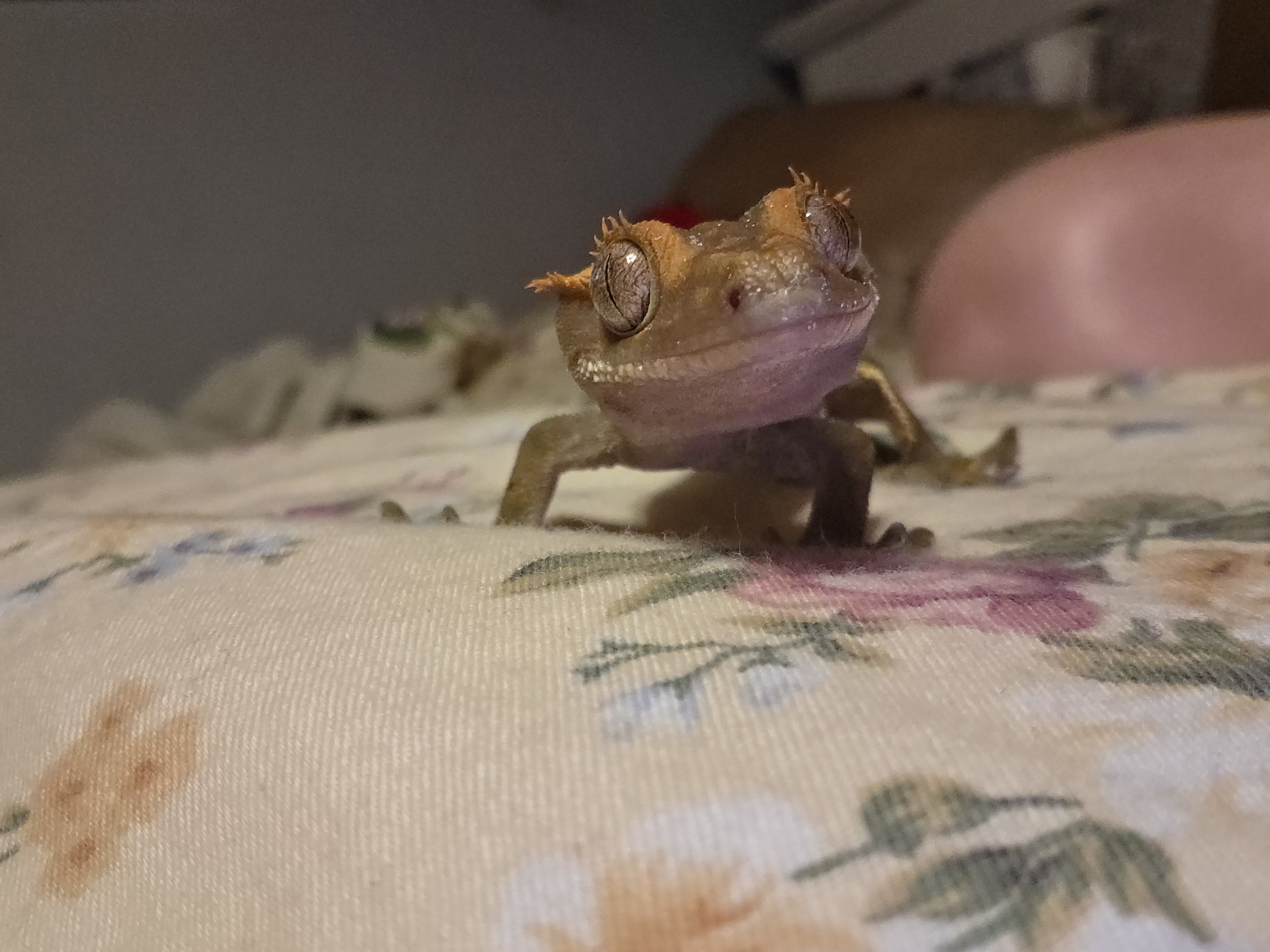
I definitely appreciate that reassurance. I feel I caught it early enough to make sure my baby is okay. He also thanks you all for the fantastic advice
3 Likes
Awwwwww I love him!  We are all here to help and support! What’s his name btw?
3 Likes
This is Mars he is a halloween pinstripe and about to be 10 months! He is super sociable and loves hanging out lol
2 Likes
Mars! I love it! I love unique names! Good for you for taking good care of him! 


2 Likes
All crickets need to be dusted with Repashy Calcium Plus. Repashy Calcium Plus, since crickets are also deficient in Vitamin A. Every time, since each and every cricket lacks A, D, and sufficient calcium. Dusting each one rectifies the levels of those nutrients in the crickets
3 Likes
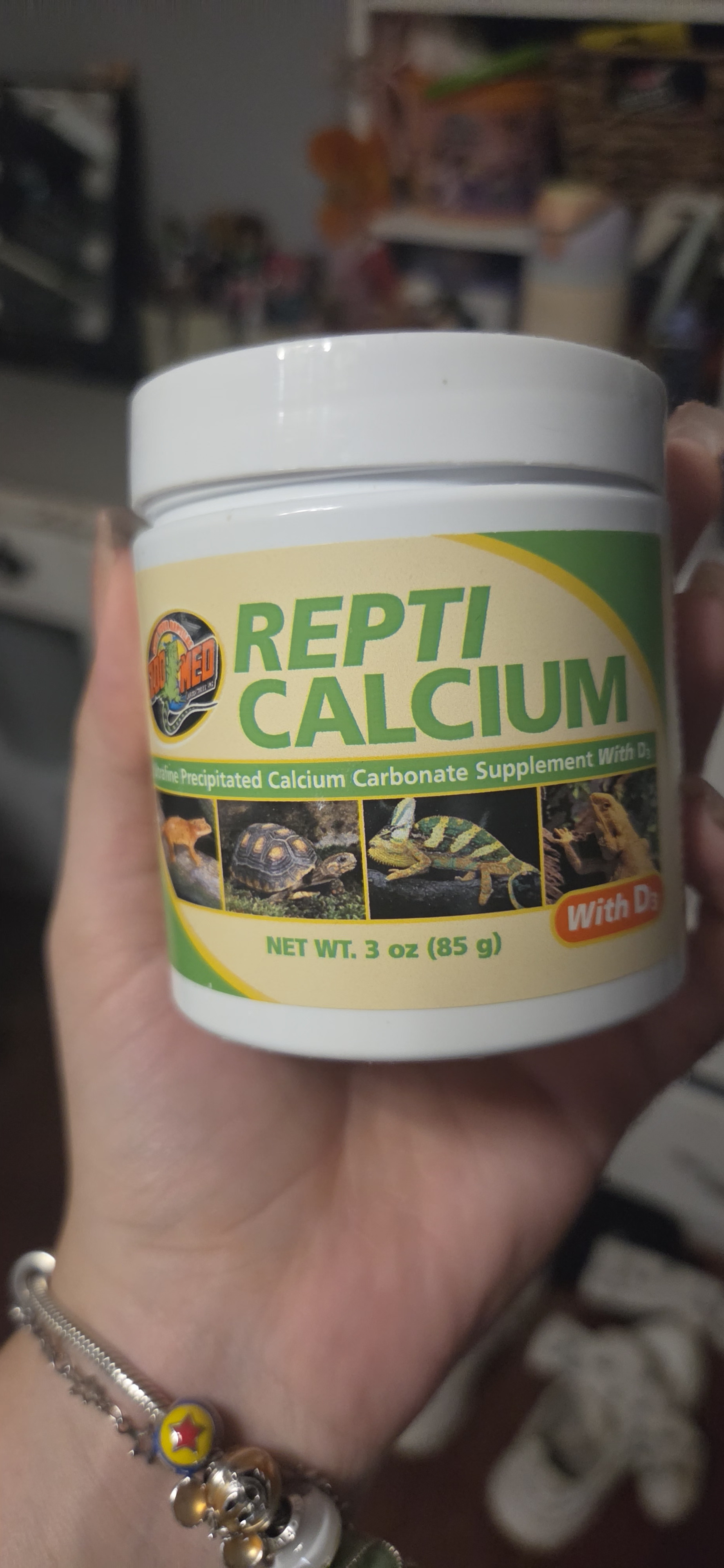
Yes definitely! You can keep that tub on hand in case you run out of the Repashy.
2 Likes
That’s not sufficient for dusting insects. I would toss it. Supplements should be kept in the fridge, and discarded 6 months after opening, too.
3 Likes
So switch to repashy and refrigerate it got it!
3 Likes
Ive never heard of anyone recommending dusting insects for crested geckos with anything other than calcium + d3. Extra calcium is needed to offset the added phosphorous, but CGDs have all the vitamins the gecko needs, and as far as im aware, there’s nothing in insects that would affect the vitamin A levels, the same way that added phosphorous can affect the calcium levels. Since vit A is a fat soluble vitamin, i wouldn’t be adding anything extra all willy nilly, unless someone can explain what exactly causes the extra need 
3 Likes
So when I dust insects should it be with what I use or repashy? In your opinion
1 Like
I would just go for calcium + d3, or pure calcium if you’re offering UV. Zoomed, arcadia, repashy are all decent brands afaik. I could see vitamin/mineral deficiencies being an issue if you’re feeding mostly insects, but as long as we’re talking once a week and CGD for the other feedings, it shouldn’t be an issue. Just checked Reptifiles as well, whose careguides are known for being some of the most up-to-date when it comes to advanced, research-based care, just in case i had missed something, and even she doesn’t mention anything other than calcium + d3. Here’s a direct quote from her care sheet “Supplements: Crested gecko diet is already fortified and balanced with a variety of vitamins and minerals. However, feeder insects need to be “dusted” with a light coating of calcium powder to balance the calcium-phosphorus ratio.”
2 Likes
Thats really interesting. I will have to look more into it as well. The pangea is filled with good nutrients but with a lightly dusted crickets will also solidify his diet
2 Likes
The reason I tend to note Repashy Calcium Plus by name is to avoid recommendations for ‘multivitamins’ or ‘calcium’ since there are a range of products available, and sorting through them takes a lot of knowledge. RCP is a go to for all insect dusting needs for all herps.
Directly to your recommendations:
Prepared CGD has a sufficient amount of Vitamin A such that if a crestie is fed only CGD it will get a sufficient amount of Vitamin A. CGD cannot have “all the vitamins the gecko needs” for any and all ratios of CGD to insects, of course, and I don’t know of any evidence that skipping vitamins some number of times a week is warranted. Hypovitaminosis is easily 100x more prevalent than hypervitaminosis in captive herps.
Captive raised crickets contain roughly zero Vitamin A. Each unsupplemented cricket that a crestie is fed offsets the sufficiency of the overall amount of Vitamin A in its diet. On the ‘crickets don’t need to be supplemented with Vitamin A’ logic, they don’t need to be supplemented with calcium or D3 either.
There’s absolutely nothing at all “willy nilly” about it. What it is, is ensuring that each thing the gecko eats has a proper amount of nutrients. Dusting crickets doesn’t supplement the gecko; it supplements the crickets, since we have little knowledge of how much Vitamin A a gecko needs (differences in age, growth rate, activity level, reproductive status, etc would make this pretty much impossible to determine), but we have a pretty good idea of how much Vitamin A a cricket needs to be nutritionally decent.
Phosphorus doesn’t affect calcium levels, exactly. Ca and P need to be in a ratio of something more than 1.5:1 (better 2:1 or 3:1, and some wild herps’ diets are 6:1) in order that metabolic processes go as they need to.
But there is something in Calcium with D3 that affects Vitamin A levels, at least in some situations. Vitamins compete for digestive uptake, and when they’re outside of the ratio of 100:10:1 (A:D3:E), the vitamin that’s high gets selectively absorbed at an even higher rate. You can give an animal a Vitamin A deficiency by providing too much Vitamin D3 (or E, but I don’t know that that’s ever selectively supplemented). Selectively supplementing one or two of A/D3/E is not consistent with facts about vitamin uptake.
Additionally, there is no – none, zero – risk in using a balanced complete supplement in this situation (that is, dusting crickets that are a portion of the overall diet), since the presumed safe long term dose of Vitamin A (and D3, for that matter) is 4-10 times the baseline needs (citation in Mader’s Reptile Medicine, p. 206). There’s no way to get even four times the supplement to stick to a cricket.
With all that out on the table, it is very unclear why anyone would use plain Ca or Ca/D3. Other than completely unwarranted overdose concerns, there’s just no reason.
Regarding sources of information:
Reptifiles is an Amazon affiliate site (that is, it needs to sell products) run by someone with some book (and mostly internet) learning and not a whole lot of first hand experience. “Evidence based” there is as much a marketing phrase as anything, and is used more as decoration than a foundation. It isn’t hard to find stuff that’s either wrong or just parroted misinformation, and obviously many of the recommendations are driven by Amazon clicks, but it is a slick site so people want to believe it.
1 Like
Thank you! I have never trusted Reptifiles. There was something about the way the information was presented, robotic? I didn’t realize it s connected to Amazon, This explains my gut feeling of mistrust. I want first hand experience advice.
3 Likes
The reason I tend to note Repashy Calcium Plus by name is to avoid recommendations for ‘multivitamins’ or ‘calcium’ since there are a range of products available, and sorting through them takes a lot of knowledge.
That’s fair, it’s great to have a go to that you know works, nothing wrong with that
Do you have any evidence for this, in crested geckos in particular? I imagine herps that are not fed a prepared diet this is easily correct due to human error, however i have not heard of a single instance of cresties after CGDs were made available. Not saying it isn’t correct, however since the diet in captivity for new-cal geckos is different from the average herp, it cannot be directly compared.
Vitamins compete for digestive uptake, and when they’re outside of the ratio of 100:10:1 (A:D3:E), the vitamin that’s high gets selectively absorbed at an even higher rate.
Calcium and phosphorous have an inverse relationship. That is why in every single living animal, you need more slightly more calcium in the diet than phosphourous, otherwise the body will draw calcium from the bones in stead of using the freely available calcium to create calcium phosphate. So those do in fact directly affect eachother. Insects (and fruit for that matter) are naturally high in phosphours, and CGDs are only made to be balanced within themselves.
Fatsoluble vitamins do in some cases compete for absorption, but as far as im aware this is only the case in very very high doses, much higher than what is needed or in CGDs or supplements. At normal levels and ratios, it shouldn’t be an issue. I live in a country personally where we have to take calcium + D3 supplements 8/12 months a year, and the average supplement does not contain anything other than vit D, calcium and occasionally magnesium. Do you have any evidence that this also happens at lower/normal levels? If this was a general issue, I would suspect vitamin issues in animals fed CGD + insects with calcium + D3, would be a pretty normal occurance, yet it doesn’t seem to be. And that is arguably the far most common and recommended feeding regimen. And I would also assume that us people living far up north where vit d supplementation is a normal part of life, would be supplementing with other fat soluble vitamins as well, if the fatsoluble ratios were nearly as important.
That’s completely fair
Being an amazon affiliate is something almost anyone can be, and obviously if someone dedicates a lot of time to something, it’s nice to get a little bit of money. Amazon is a marketplace that sells tons of low quality stuff, but also tons of great products from trusted brands. If she can get a bit of money from someone buying an Exo Terra from Amazon rather than Petco, and that’s what keeps her blog running, i see no issues with that, even if Amazon suck. She also specifically states that she actually gets better rates from her other affiliates. She also recommend products that she does not in fact get any commision from recommending. And she links to research papers when relevant.
Could you point out some of the stuff that is easily proven wrong? I don’t necessarily agree 100% with everything on there, especially in terms of minimum recommendations, but ive yet to see anything that is downright misinformation, albeit i have not read every single one of her guides.
Overall, I concede that supplementing vit A likely won’t cause any issues, I don’t see any strong evidence that it is needed though
2 Likes
I don’t have hard statistics to offer, especially not for one particular species. A look to vet literature will show scads of incidents of, and discussions of, hypovitaminosis A and D, and a dearth of reports of hypervitaminosis in herps (basically none from realistic dosing of powdered supplements).
I’d prefer something like ‘experienced thoughtful keepers can show the ways in which this is a bad recommendation’ rather than ‘easily proven wrong’. There’s not a ton of “proof” in animal care.
Supplementation of rodent prey with a multivitamin because supposedly “Some studies have revealed that commercially-bred feeder rodents are deficient in crucial nutrients like vitamin D”. Feeding a complete balanced vitamin won’t correct this alleged deficiency, because of selective uptake (I’m not exactly saying this is a danger or similar; I’m pointing out the invalid reasoning).
Recommendations for (among other enclosures) glass enclosures for herps. With many of the species that I breed (and have actual experience in helping numerous new keepers navigate the transition to a new environment), moving into a glass enclosure is stressful and can make them stop feeding. The author has (as far as I know) no first hand experience with new, inexperienced owners and housing choices. Someone who has only kept a species – and not bred and sold and seen animals go off into the world, and heard back about how they’re doing – has a somewhat limited understanding of their needs.
The push to market Reptilinks, which per my experience and talking to others, have a very low acceptance rate. This is an example of financial incentives skewing recommendations – there’s a lot of this on the site; the recommendation to purchase a MistKing for a rainbow boa is another one.
“Ideal daytime humidity will be between 30%-40%” for a leopard gecko; Mohammed Khan (Pakistani herpetologist) states that macularius in the wild stay in their hiding areas unless RH is above 50%. This is an example of parroted misinformation, not “evidence based” recommendations.
Night temp drop for rosy boas: “Heating should be turned off at night. Temperatures can safely fall to 60°F/16°C.” Presumably this is because of the idea that deserts get cold at night. For the next seven days in Borrego Springs the temp isn’t forecast to fall below 80F. Same in Ajo, AZ. Also, all my rosy boas thermoregulate at night (as do wild snakes – consider snakes on asphalt pavement into the early night hours, as long as that pavement is retaining heat).
For rosies: “Prey should be thawed in a plastic bag in warm water to around 100°F/38°C before offering.” No reason for this, since they don’t detect a heat signature. Room temp is completely fine; complicating things unnecessarily is, well, unnecessary – but it does make the site look more sophisticated and that’s likely what’s going on with these sorts of recommendation.
For rosies, a suggestion to feed, among other prey items, green anoles.
And so on.
1 Like