Hey guys so I have recently gotten a ball python I have a appointment next week at a vet to have it checked out because the previous owners I got it from had it’s enclosure full of mold and filthy so I want to make sure it’s in good health. The questions I have are really what type of tips do you guys have to make sure I give it proper care, such as the best bedding to use and the best way to make sure I keep it’s humidity levels and such to proper conditions, please don’t belittle me for lack of knowledge im generally just trying to make sure I am giving the best care I can and giving it a life it deserves
4 Likes
Welcome to the community! No need to worry about the people here belittling you for simply asking for care advice to insure the welfare of your animal. This place is different. Kudos to you for rescuing that beautiful animal btw!
As far as care advice, I will leave this to the others here because my way of doing things may not be the best way for you and your situation.
Please do not hesitate to ask any and all questions you have. You will be treated respectfully I promise! 

1 Like
Here are a few tips to get you started 
• Get a scale that weighs in grams. It is important to be able to weigh your snake to ensure it is staying at a healthy weight and to decide what it should be eating, they will need rats that are 10-15% of their total body weight. You’ll most likely get your snake’s first weigh-in at their vet appointment so you’ll know where to start.
• For substrate I’d reccomend paper towels just for now since it is a new snake. This will allow you to easily clean their enclosure as well as monitor for anything that might be an issue (snake mites are easy to see on paper towel, for example). I’d use paper towel for around a month until you know your snake doesn’t have any issues. Then you can switch them to reptichip, you can find this substrate on a lot of online pet shops or Amazon, however there are a few more options.
• For basic humidity and temps you’ll want your warm end to be 84-86°F, cool end 78-80°F. Humidity should be 60-80%. You can increase humidity by providing enough water and giving your snake damp sphagnum moss.
• Feeding should be done every 7-14 days. Do not handle your snake the day before, day of, or day after feeding. Make sure you have plenty of hiding places for your snake and that their temps and humidity are adequate or you might run into issues with your snake refusing meals.
These are just some of the basics. If you have any specific care questions outside of this feel free to ask
5 Likes
I have to respectfully disagree about the humidity. The humidity should be 50 to 60 percent unless the ball python is in shed, in which case it can be raised a bit.
3 Likes
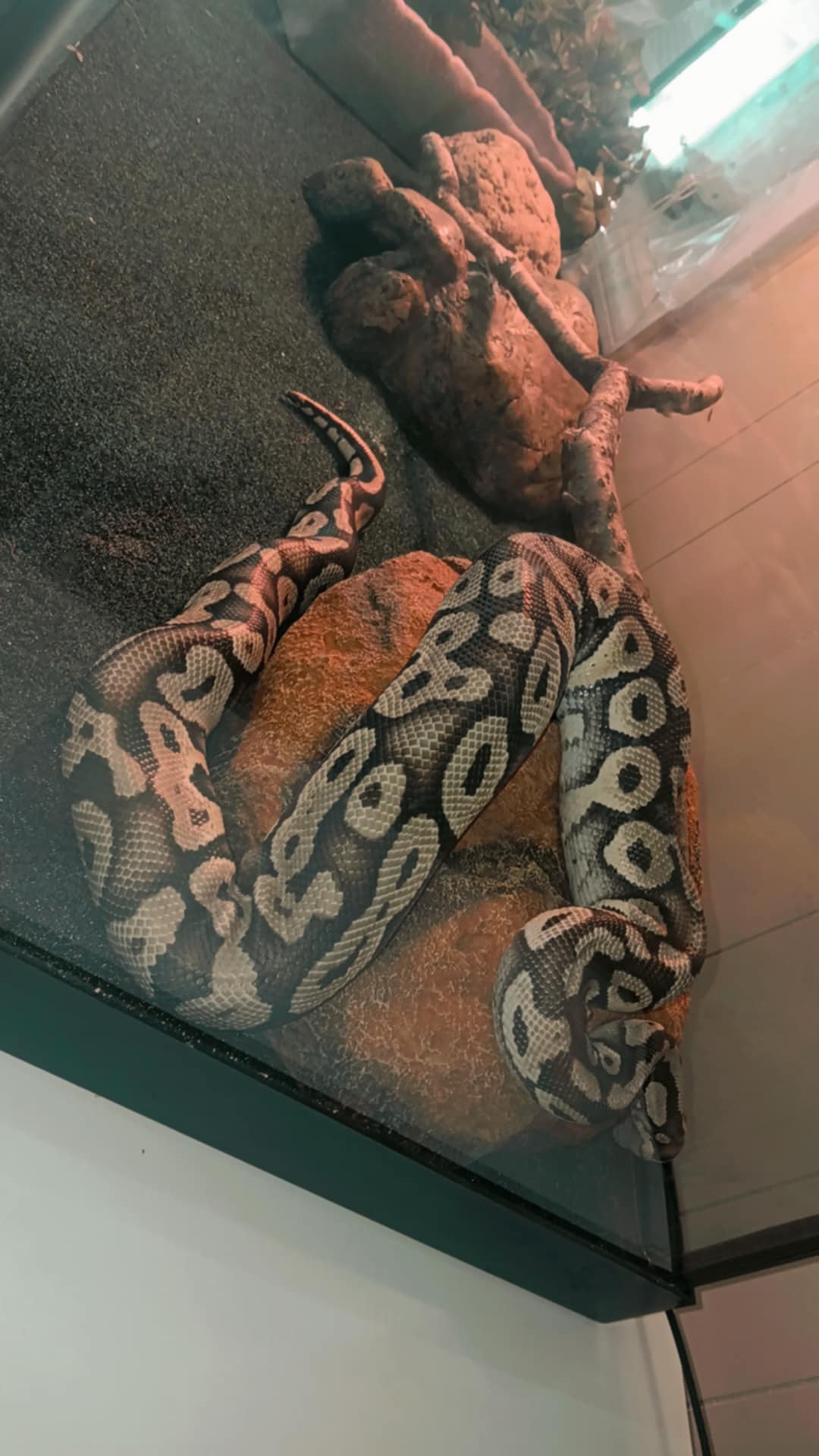
Thankfully, body wise this noodle looks to be in pretty good shape. So at the very least they look like they’re eating pretty well. Maybe too well. Lol.
If your vet is able to sex your snake for you, that can help out with the body condition. If your snake is a male, he’d be what I consider obese. I would consider them overweight if female as well, just not quite as much grams to loose.
For the heating, I have cats and keep it simple with belly heat with mine. But an undertank heater or heatpad needs to be regulated by a thermostat otherwise they can superheat and cause burns. Even if using an overhead source like a ceramic heat emitter, you want to make sure if it’s too hot it gets set to a dimmer or a thermostat shutoff.
Sometimes you get the lucky sweet spot where your thermogun is reading perfectly because the distance and the overhead heat are aligned.
If this snake is used to eating live meals, I would try to switch them to frozen thawed if you can. This just makes it safer for the snake because they avoid bite wounds, and is more humane overall. Rat bites may start small but can sometimes cause nasty infections. Ball pythons can be notoriously picky sometimes, so if they’re really resisting, don’t take it too hard.
Thank you for taking this little one in and wanting to improve things.
2 Likes
No worries, we were all in your shoes at one time. I just wish I had the internet back then, we thought we were so smart for inventing the wheel when I was young, lol!!! You have gotten solid advice already. I do hope if you have other reptiles you kept this BP and his enclosure away from the others. If you can afford a PVC enclosure I highly recommend getting one. Check Marketplace and Craigslist to save a bunch of $$$$ I have kept snakes for most of my 58 years and nothing makes holding temps and humidity easier than the PVC enclosures. I use nothing but the CoCo Chip for substrate as it also helps to maintain humidity so you’re not having to spray water constantly. The digital gauges today are just awesome but make sure you get decent ones. I just picked up a double pack of InkBird temp and humidity gauges that allow me to check the readings on my phone. The sensors they use in them are Swiss made and very accurate. Amazon had them on their Deal Day Sale for $14.99 for two. Now I wish I would have bought several more. Control your heat with a good thermostat and you should be good to go. If I can help answer any specific questions just shoot me a PM. I’m new here as well but I’ve been keeping snakes a very long time. Congrats on your new BP and hats off for getting this one out of a bad situation. Later
3 Likes
Sorry for the late reply recently people are now saying 70-80 % humidity is because below 60 is the minimum can cause the mucus of the ball python to dry out and cause resptory infections apparently this coming from the ball python community on reddit which has been giving this advice out to thousands of people
2 Likes
Nope. 50 to 60% is correct. There are other people here more experienced than me who will back me up.
2 Likes
Yeah I’ll have to agree.
I used to believe it was 60-80% but I after you replied I read into it a bit and found something I believe @ballornothing posted about higher humidity actually not being the best for BPs, correct me if I’m mistaken I didn’t have the time to actually go back and look for the specific post.
I actually have discovered that 55% is the golden spot at least for my BPs as they have perfect sheds, their substrate isn’t overly damp and they have no respiratory, skin or shed issues otherwise. They have access to more humid spots where there is sphagnum moss they can hide in when they are in shed but their overall ambient humidity never goes above 62% if there are no spills from their water bowls or we have bouts of really humid Texas weather, and if it dips any lower than 50% I’ll mist their sphagnum moss a bit with warm water and keep an eye on it until the parameters even out.
When I used to keep them at higher humidity (75-80%) I had a terrible issue with substrate molding and I went through a lot more substrate than I do now. One of them had a tiny spot of scale rot on their scales that was cleaned and treated with betadine and it cleared up after a shed and I removed the substrate and replaced it with something not as damp.
3 Likes
The ball python community on reddit is a dumpster fire. It’s the last place I would seek information.
Humidity too much over 60% without carefully managed air exchange will cause mold growth in most climates. Lower humidity will not dry out their ‘mucus’ or whatever unscientific point they were trying to make. I’ve never had a respiratory infection in a ball python that didn’t have other serious health issues in over a decade and I keep humidity between 45-55% at all times.
5 Likes
AMEN Don!!!
(I would add FB as well!)
3 Likes
What a perfect description, Don @ballornothing ! Dumpster fire, ha! I’m going to incorporate that into a conversation today I think!
3 Likes
I was thinking it but I was conflicted on whether or not to say anything about it in my recent comment lol.
There are a few good ppl there but theres just so much conflicting information and opinions that it drowns out any actually useful information. There are a lot of people there as well that will die on the hills they stand on and any other opinions or information that comes their way they treat like the devil.
They are also often extremely disrespectful to people just trying to learn and grow.
Thats also on top of information spread around that is blatantly harmful to the animals.
4 Likes
And that my dear is the most important part!
3 Likes
Yeah the conflict information is really confusing me to the point where I’m worried that I might be harming my ball python because idk what is good advice and what is outdated and ball python community on reddit is giving this advice out to millions of ball pythons owners every day and then people on here say the opposite of what they say then I’m stuck at square one all over
Frankly, I’d trust the folks here over Reddit. This place is populated and moderated by people with years and years of real world experience keeping and breeding reptiles. I get the sense that many Reddit users care more about virtue signaling and feeling superior than being genuinely helpful.
You definitely don’t need to keep a ball python at anything over 60% humidity. Most do great in the 50-55% range. You can always give them a humid hide (line a plastic hide box with damp paper towels or sphagnum moss) that’s closer to 80%, so the snake has access to that higher humidity if it needs/wants it.
I keep two species that need higher humidity than bps, and even so, I keep their humidity at the lowest level possible for them to shed well, and I let the enclosures dry out pretty well before I add more water. Keeping things constantly wet and damp just creates a breeding ground for mold, fungus, and bacteria, which can be very harmful to your snake.
You really don’t want to go overboard on humidity. So long as they’re hydrated and shedding well, that’s what matters. And bps don’t super need high humidity to accomplish those goals.
3 Likes
Everybody here has given some expert advice. I’ve only had my BP a few years, but here’s my best Hack/tip:
Get a luggage scale of the type that you hang the weight from by a hook, and a drawstring cotton bag big enough to easily put your snake inside. Weighing an enthusiastically curious hosepipe is a bit tricky but if you put them into the bag, then weigh it by the bag strings on that kind of luggage scale, you will be able to do it much more easily.
Other tip: A Snake Log!
Get a notebook and write the date, time and thing you are doing with the snake or observances made. You can keep good records of how their droppings look, how regular urates are happening, their weight, what you are feeding them and how often. That way if you ever wanna know how much they weighed a month back, or anything else, you have notes. I had fun making mine out of a little fantasy-styled leather covered notebook I had but hadn’t decided how to use.
2 Likes