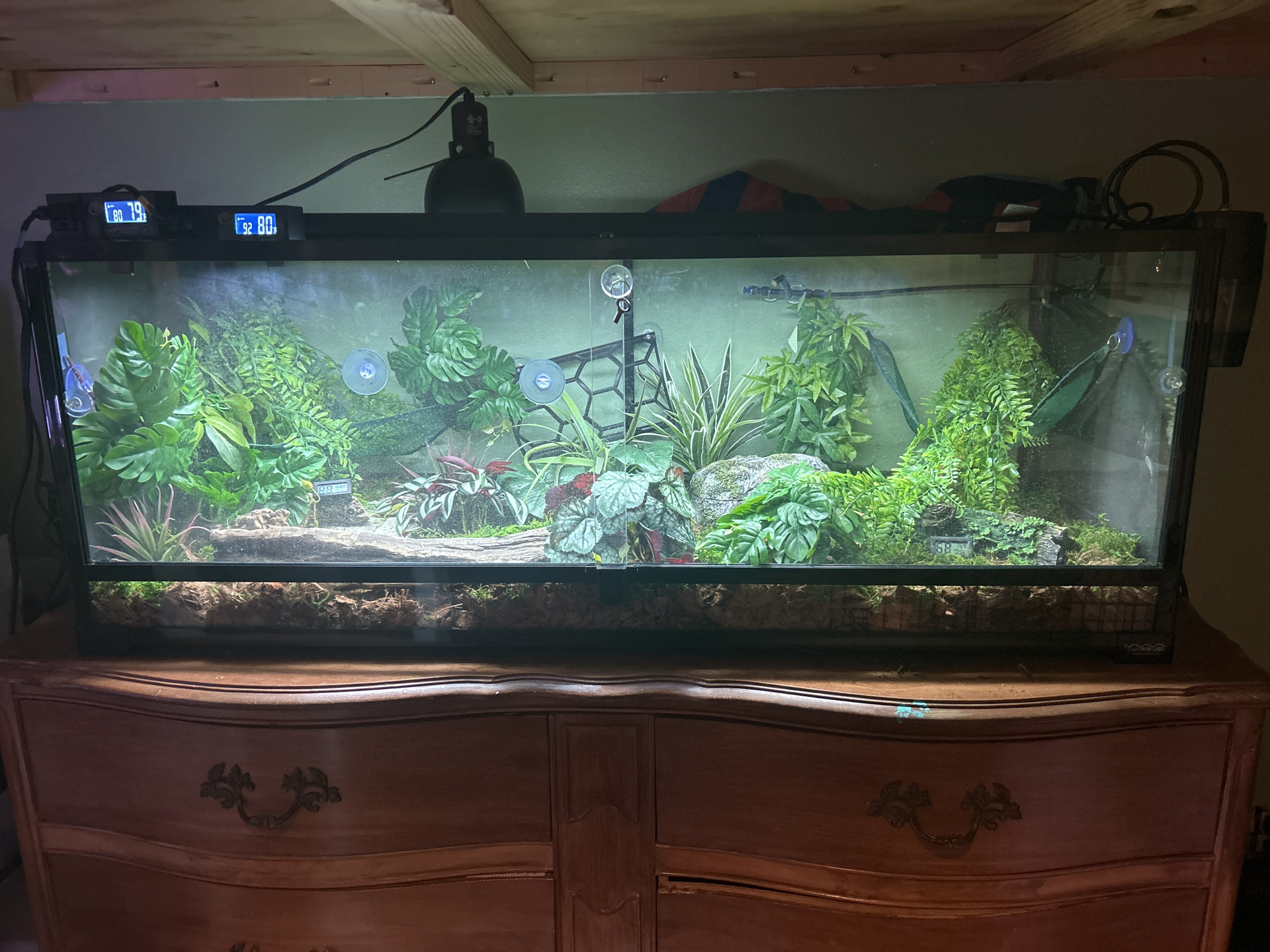
Tubs are for rack breeders who need space opts. This is your first snake, give it your best pls! Dont you dare buy the snake until you’re absolutely 10,000% on EVERYTHING you will need. I didnt get this option with my bby, so I hope you do.
Ball Pythons are beautiful animals, but breeding racks n’ tubs are not for pets. Try to obtain a front-opening, lockable enclosure. GLASS loses heat easily and Theyre stupid expensive and heavy. PVC is plastic and can overheat and melt if done wrong, plus, sizing is inconsistent and rudely difficult to find furniture for.
I honestly recommend a grow tent, which are actually pretty good when you turn them on their side, or a PVC (which you can DIY or even modify for pretty cheap) with a metal mesh top and front-opening tank.
You will want as many opportunities and options for enrichment as physical possible. You do not have to spend 100s of dollars on Amazon or anywhere else tho, because well-cleaned outside sticks that dont have sharp points are perfect.
You’ll want AT LEAST 2 hides, at LEAST. If space allows, I also strongly recommend a third humid hide. Especially if you live in a drier place and it’ll be more difficult to keep up ambient humidity.
As many “plants” as you can possibly shove in one square inch is the preferred method. Live plants are a waste of money as they can get easily killed by a bp.
Do NOT EVER feed your snake live if you can possibly help it.
ALLL HEATING ELEMENTS NEED A THERMOSTAT TO MAINTAIN THE CORRECT TEMPS AND PREVENT OVERHEATING, put probes wherever you are maintaining the head.
At least two hydrometer/thermometers for monitoring cool and warm side temps and humidity in the air. Try to get digital like ink bird because those are much more effective than a simple gauge, which can be kind of vague.
For substrate, there are loads of options. Right now im using coco husk with a half inch top layer of green moss, it holds humidity well, and my snake loves it. Moss is also utterly perfect for sheds and humid hides.
Try to keep the ambient/overall humidity under 80 and over 60%. This keeps your noodle hydrated without overcooking (RI) it or letting it go stale (dehydrating).
Warm side temps shouldnt exceed 90. Ever.
Cool side needs to be above 70 at all times.
Night vrs. Day flux of light and heat is good enrichment. It can keep your noodle from getting confused and turning into a durian.
Try to feed in the evenings or early mornings if possible.
Weigh your snake AND the chosen feeder before EVERY. SINGLE. FEEDING.
Do not handle your noodle for AT LEAST 48 hours after feeding unless emergency.
Do not feed fowl-smelling or visibly rotten feeders. This is like taking a week-old pancake out of the couch and feeding it to yourself.
Good luck!!!

 I was NOT prepared but she at least came home with her original 20 gallon and UTH.
 but thank you for making me question that which seemed not completely reasonable to begin with.