On Ball Python Cohabitation

Thanks for this comment; I think it’s incredibly fair. :pray:

I’ve been thinking about the rodents example…I kinda wanted to say something to this end but I really feel @caron’s sentiment and need some relief from this discussion.

Quickly, I feel like there are a few subtleties to acknowledge there - hugely different metabolism and levels of activity, higher complexity of observable pro-social behavior, and consistent evidence of intrapersonal conflict when keeping dense populations in constrained habitats. Despite this, I’ve observed many cases in this industry of rodents kept far below the research standards we practiced…but see virtually no outrage relative to that directed at ball python cohabitation. Mouse stress isn’t on most people’s minds.

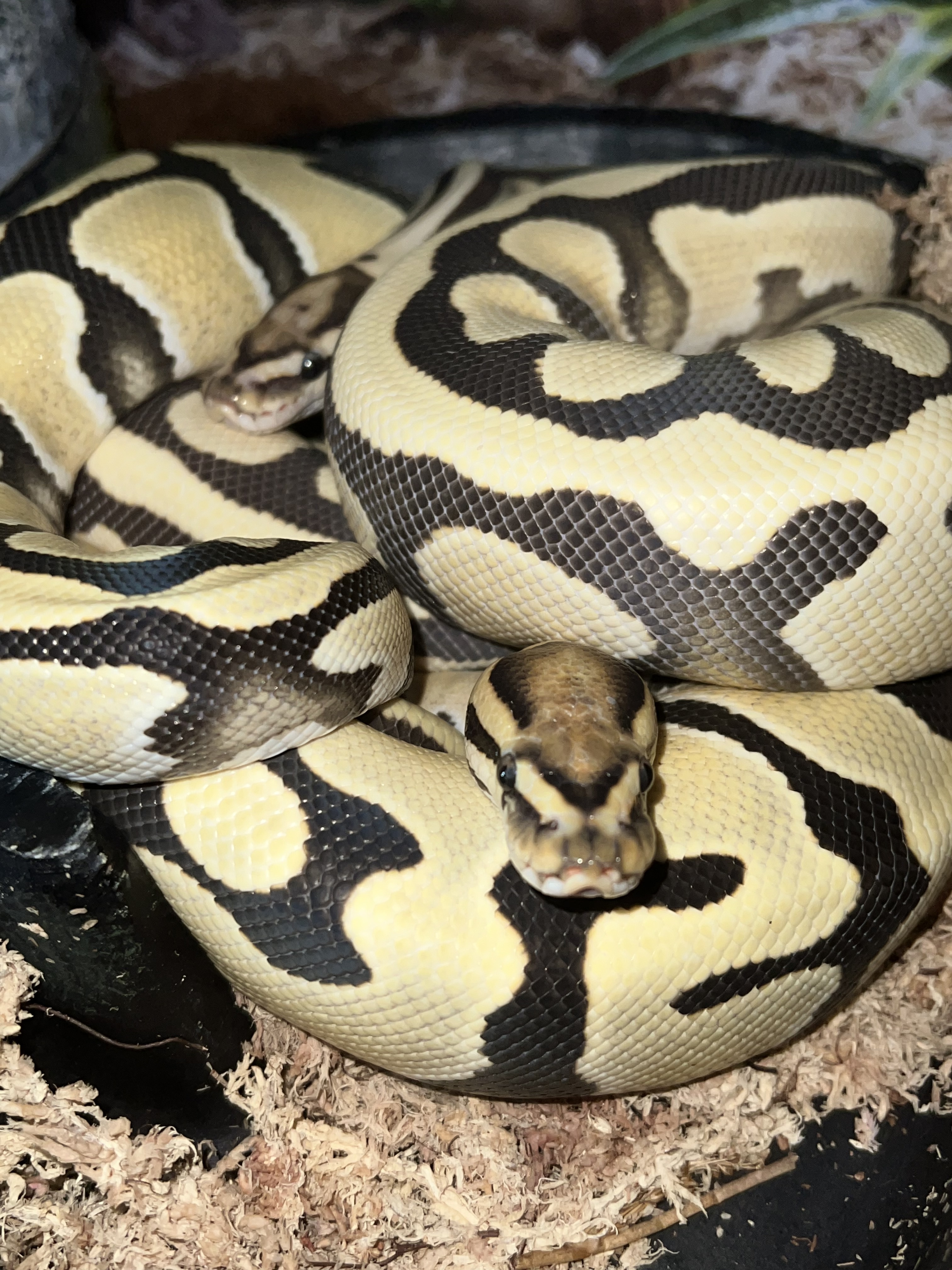
I rarely see them alone in my habitats, and almost never for more than a few hours - typically when polling as they roam. I sense them falling into a kind of energetic sync, hence the propensity to roam together. If I replace one, it will almost always prefer snek pile to empty hide. It’s very consistent. Note the recent pics - initially after replacement one was separated, but that only lasted a few hours. The last 4 days they haven’t budged from one pile. The hide remains empty.

But I still agree that the tub in question has crossed the limit of reasonable space as they’ve grown and lacks sufficient enrichment.

Signing off!

8 Likes

Perhaps not in this community, but I assure you that if you went into an online community of rodent-lovers and keepers, you’d see all kinds of outrage. Of course, many of them would be outraged at the mere notion of raising rodents to feed to other animals, but my point is that the level of “outrage” at any given situation is highly dependent on who you’re asking. It’s not surprising that on a reptile forum, perceived mistreatment of reptiles would generate more outrage than perceived mistreatment of feeder rodents.

I don’t really have anything else to add that hadn’t already been said by someone else. I just hope that if you continue this “experiment,” you move your cohabbed snakes into more appropriate enclosures with more space, hiding places, and enrichment.

9 Likes

I’m very curious to see how they do as you get those new terrariums set up, Wes. What kind of tests have you done with multiple smaller hides in the same cohab area? I have heard that cork bark halves tend not to be a fav of many BP’s, but if you had three or four smaller options, would one or more cohab juveniles crowd in?

I think there’s validity to your work, and I see what you mean about bias working at such a subtle level that even level headed responses are coloured by it. I’m not sure how you’d work around that; it almost seems like you need to be running another test, the second one on humans to ferret out where our biases have been built so that we can consciously examine whether they’ve been built on solid data or are mostly based on gut reactions. That seems to go both ways though.

Best thing for heated discussions is to take a rest, change parameters, and try again, which seems like you’re doing. Thanks for sharing everything you’ve found so far.

8 Likes

Wes, I truly applaud and throughly have enjoyed reading through this entire thread. You are someone after my heart in the regard of watching, studying and wanting to better understand and care for your Ball Pythons.

My husband and I got back into keeping BP’s this past year, and we have a small collection of 12 that belong to us. We had gone back and forth on the idea of cohabitation, but after some discussions in person with Kevin McCurley we felt confident enough with the idea of trying to possibly cohabitate a pair of sisters we got from a different breeder. I can honestly say that everything that you have described over the course of this thread is exactly what I have seen with our sisters.

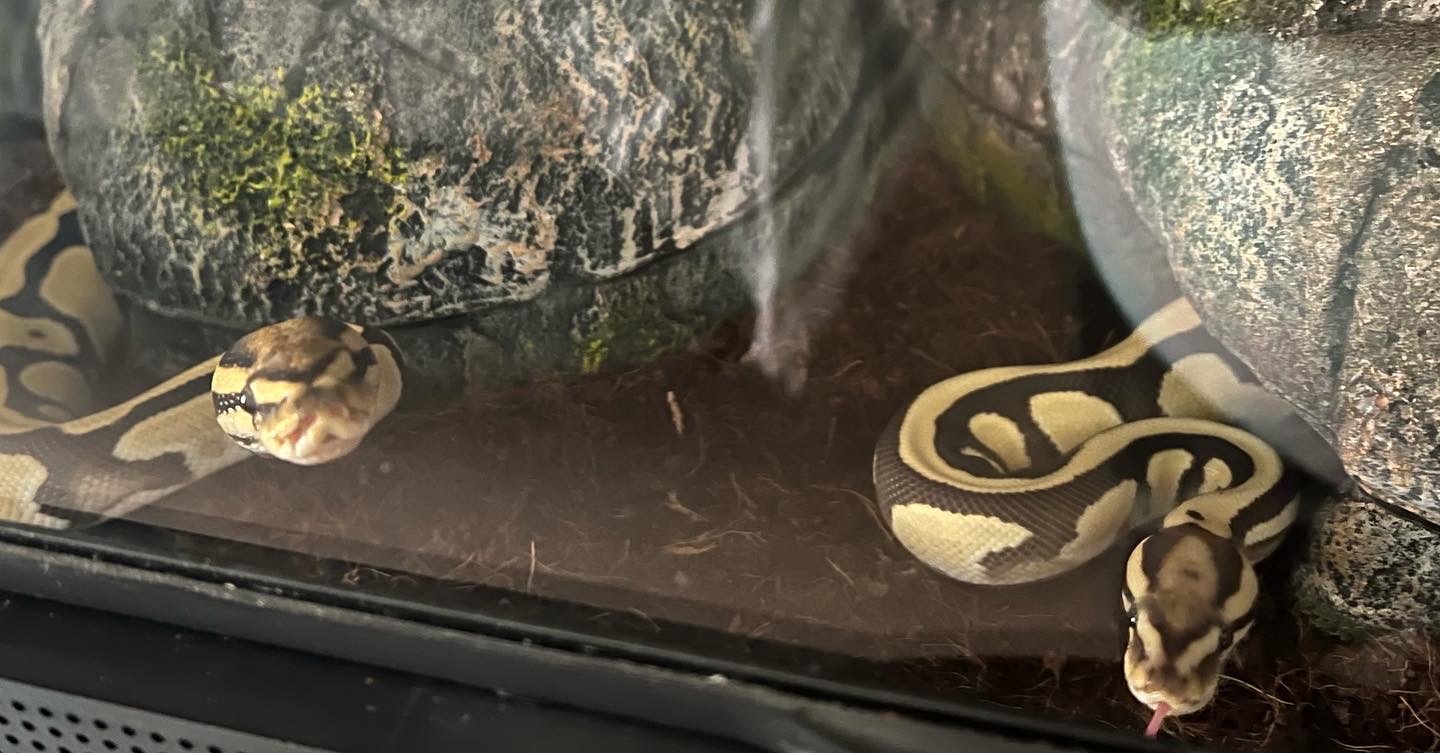
They have space/hides/heat sources to be completely separate from each other all of the time if they so chose, and I would say that the vast majority of the time when we open their enclosure they are curled up together. As you can see in the picture I’ve attached. They are very healthy and have great feeding habits.

With food entering the room, this is what I am usually greeted with, as both will come out up to the glass ready to grab food. I’ve never had any mistaken strike attempts with them at each other, but I have had the sister with the Fire gene take a lunge at me a couple of times because I was trying to reach around her and my hand and movement caught her attention. Again, it wasn’t even really a strike, more like a “give me the food” already! :joy::see_no_evil::speak_no_evil:

Truly though this has been such a great read, and it truly makes me feel good to know that I’m not the only one seeing these sorts of things. Ball Python’s may not be in the same league as a Water Monitor, but if Reticulated Pythons can be seen as “intelligent” snakes, why is it so hard to believe that Ball Pythons could be similar? Also, Ball Pythons have now been bred so many years in captivity now that they can be considered domesticated animals. Is it not possible that we as humans working with them have helped to begin or create an evolutionary change in their behaviors or mental processes???

To me there truly is so much to learn and understand about these animals. Look at what we are only now discovering about genetics in Ball Pythons!?! If that doesn’t tell people that we don’t have a full understanding of them, nothing will.

13 Likes

I cant help with the dieing plants, as ive yet to be successful on that front, but i can say when it comes to smell i havent changed my bioactive substrate in about a year and the isopods have kept it super clean. (I will say i hav done some scrapings of the top layer of fras to keep too much of a buildup. What bioactive mixture were you using, was it drying out or remaining too damp? I have cohabbed for a few months out of necessity before while setting up more enclosures, but not as a permanent setup (i havent the space for a proper cohab, id be more willing with a 200 gallon tank or a 8x4x4). But when it comes to bioactive, ive had a lot of luck keeping them going with minimal effort so may be able to shed some light on that front.

I understand others concerns, and appreciate the effort you have gone through to explain your standpoint and methodologies. I may not agree with them, but it at least shows you are willing to have civil discourse, which is one of the primary things we like to have here (this isnt facebook, and nobody should be looking to crucify anyone here unless it is animal abuse to the point of major injuries or animals starving to death etc.)

I agree with others points about the hides, i believe the snake went to its siblings to hide in the pile since there was nowhere else to go, not because it was its prefered choice, however were there other places to choose and they still went for the siblings, that would have been interesting as that seems like hatchling mentality and I would wonder if they arent seperated if they keep that mentality as they grow, but thats a different thing.

Judging by your responses it seems you are taking criticism well and understand for some, what you are doing crosses a line as many before you have and many after you will continue to experiment with cohab to try and save a buck when it comes to enclosures. That isnt me saying this is your reasoning, only that it is not uncommon, and some take offense to it and you are likely to get grouped into it, even with the best of intentions.

IF this is your intention, I insist you reconsider your standpoint. IF you have a legitimate curiousity, then i would urge you to take a moment, set up exact questions you want answered, have a goal in mind, and work to answer those questions. Simple observation with no pointed subject of study may find curiosities, but will be ultimately useless later as there will be too much inconsistency to really use any of the observations. Make sure you compare to controls, etc.

I think you caught a lot of criticism on the last post with the 4 yearlings in a tub because as you admitted, it was clearly not an optimal setup. The amount of stress before the food smell was even introduced in that setting was likely high considering the lack of security. Baking some bark or branches to give some semblance of concealment and security likely would help their situation a lot and be relatively cheap to do, just ensure you are baking the items long enough to ensure you arent introducing hitch hikers, and also that nothing you grab is pine of any sort as the phenols are poison to them.

I can understand not having enough time in the day, but make sure it isnt the animals who suffer for it. Its easy to forget about the repercussions when your mind is busy elsewhere.

No attacks, just simple things i think its important to be aware of and keep in mind :slight_smile:

10 Likes

this is why I love this forum, they can turn a single thread into a 50000 thousand word essay on ball python co habitation like fr if we took all of this information we could make a publication from this one thread EASILY

7 Likes

This was a very informative read! It’s so nice to see fact based research rather than seeing everyone jump on the “just don’t do it” bandwagon. The Facebook groups can be brutal when people ask questions out of curiosity. This thread, for the most part was an excellent debate. I only own 1 BP but I have done my own research and have found that they aren’t as solitary as everyone insists they are. But I applaud you for standing apart from the crowd, asking why, and proving that this can, in fact be done safely. Your snakes are all seemingly happy and healthy, so keep doing what you’re doing and ignore the hate.

7 Likes

Welcome to the forum @sreeves88! So glad you found us! This truly is a great place to come together and celebrate reptiles and our love of them! We have a lot of fun! There is so much experience and knowledge here and so much to learn from and discuss with each other. Stick around @sreeves88! We would love to have you! :blush:

5 Likes

Stay on course Wes, you’re in the right direction. The following is my experience and opinion. 36 years ago I purchased my first balls, before I took them home I had to build a container that satisfied my then fear of snakes, period, wife, so I built a full size coffee table with glass sides and a hinged 2x4 pine top. This was 36 years ago before all this morphism became the way it is. I ended up with 3 balls that I kept TOGETHER until 2008 when I divorced then had to rehome. My balls NEVER showed aggression towards anything. These are Ball Pythons, not Retics, I have never known anyone that had balls that cannibalized, and I have known quite a few in my 67 years of life, however I will also say the majority were single ball owners. Balls are docile by nature, the ones that showed aggression had previously been tubbed balls that had very little direct interaction with anything, including other snakes. The same occurs with humans, even though its my belief that Maslows Heirarchy of Needs still applies (Actions based upon needs). Until this year I have had no balls since 2008 when I came upon a 4 snake rehoming situation that Included a couple of spider morphs. All were kept in the same room with different enclosures. I had a few 40 gal ported tanks and bought a set of shelves that I put the tanks on. After thoroughly cleaning and positioning the tanks, a friend that was helping me replace the ceiling in my home fell against the setup knocking the entire setup over busting all 3 of the tanks on it. For those couple of days I had put 2 of the balls in another 40 I had and 2 in the coffee table. These balls ranged from 11 months to 18 months in age. What I noticed during those few days of cohab was that in both tanks the balls had done exactly as the ones I had years earlier, grouped together, even having multiple hides both tanks chose to occupy the same hide, not always exploring together but ALWAYS in the same hide regardless which hide. Since the 4 balls ( all male) came from the same location, I got to thinking “sense of smell”, they already knew each other and ended up putting all 4 in the coffee table enclosure. That was 3 months ago and to this day none have shown aggression towards the others. Occassionally each choose to single off and use a piece of driftwood hide, usually for 1 or 2 days, otherwise they are all together in one of the other 2 hides, together. I noticed recently that some breeders are afraid of knowledge, as I brought your thread into view in 2 FaceBook groups and was kicked for challenging their opinions with it. I mean really ? Facts vs myths. Being a very political man this made me wonder, why be afraid of facts? Then it hit me, if they are proven to be social then plastic container life will go out the window and costs will rise for some. If I can figure out how to post a picture or video in this thread, I’ll show my 4 males cohabitating, apparently unstressed. I always feed them in what I term a feeder tank, the other 40 tank, and they’re fed live rat/mice. I also have a 2 yr old plus female champagne, kept separately, but I believe she knows the boys are there because when allowed out a lot of times she heads in that direction. Have a blessed day.

3 Likes

I’m going to wear two different hats answering this.

Staff Hat:
Please edit your comment to remove the negative/combative wording as well as the political reference. This is a space for sharing information and ideas, there is no need for anyone to be derogatory to anyone else’s point of view.

As a reptile keeper and breeder:

The only way to effectively measure the stress level of a snake that is displaying no outward behaviors or symptoms is to test is CS levels. Without measuring Cortico steriod levels, we can only suppose, we can’t be certain. Reptiles will tolerate less than ideal conditions for very long periods of time without showing any external cause for concern.

There is at least one photo within this thread that I posted that shows what happens when a ball python eats another ball python. I’m aware of other instances in the last decade. While it is not an exceedingly common event, it absolutely has and does happen.

12 Likes

While I can follow how you arrived to some of your personal conclusions (doesn’t mean I necessarily agree), I am struggling to understand the logic behind this quoted statement.

If people only need one big box to keep all of their snakes in, how will that be a more expensive option than keeping each snake in its own box? I don’t believe cost is the reason many aren’t on board with the idea that these guys are social.

11 Likes

Or even if they don’t manage to eat the other, I personally rehabbed one that had a large wound to the throat where the other had grabbed and refused to let go. Large open flap on the underside of the neck that thankfully only went to the muscle, not piercing the esophagus or trachea.

I’ve also rehabbed a bearded dragon who had a leg so thoroughly chomped by a cagemate that all the vet had to really do was cut a tendon to amputate. That’s another species I’ve seen poor cohab advice for.

I personally have kept leopard geckos cohabbed for years. Do I recommend it to a new owner? Absolutely not. Is it cheaper than a rack tub for each? Again, absolutely not. Maintaining a 75gallon long style enclosure for 4 geckos is so much more expensive than a simple 4 tub rack system. Lol.
On top of monitoring for any signs of malnutrition, outward stress signs, and such is more work overall. It’s rewarding as heck to have something like that and watching the interactions when it’s done right. But again…done right. A coffee table for 4 snakes sounds terribly small… especially when the standard non breeder tub sized enclosure recommended is 4x2x2 for a single female ball python. Or similar to a 40 gallon tank for 1 average sized male. (Not my 2400g big boy. Lol)

10 Likes

Welcome to the forum @bharpo! I must say that you certainly jumped in with both feet for your first time posting! I usually wear the “greeter” hat” whether I can answer any questions or not lol!

In this case I choose to remain neutral because I have no experience whatsoever regarding this topic and in MY 67 years :joy: I have learned to pick my battles. In this case, until the ball python can talk, there can be no definitive Yay nor Nay to the the question.

That being said, I do hope you will stick around because this truly is a great place to be and there are a ton of truly good people here, along with a wealth of experience. expertise and knowledge to be had!

You have a blessed evening @bharpo! :pray:

8 Likes

A few ball pythons living in the same cage together peacefully doesn’t constitute “facts” or “knowledge”. It’s anecdotal evidence at best, and there’s plenty of that for the opposing view as well. If we were to do a study on whether ball pythons are healthier when kept together or in solitary cages we’d need to study thousands, if not tens or hundreds of thousands of snakes.

You don’t have enough data to back up your claims and yet you seem upset that breeders don’t take your word as truth. Most breeders are housing and caring for far more snakes than you are. Why don’t you try listening to them instead?

11 Likes

I worked at a reptile pet store when I was a teenager for a few years and in that time we always got imported(of course) baby ball pythons and twice out of the 2+ years when there was supposed to be 10 in the box there were only 9 but 1 real fat one! So occasionally cannibalism can and does happen, that’s a fact not a myth. That being said I have seen a lot of videos in Africa where they do have a ton of ball pythons all together obviously for the purpose of selling/exporting and they too seem to choose to be together no matter the space of enclosure. Now I don’t know obviously if this is anything other than environmental, heat vs cool or whatever. Just thought I would throw that out for you. I have also seen retics (on video) in Thailand do the same thing, in the wild in caves and in large enclosures in captivity now that you brought up retics!:rofl: I do have to agree with @ballornothing thougb you just can’t really tell if these co hab situations are causing stress, even minimal. I would love to see a cohabitation group eat, thrive, and reproduce together without human intervention/coaxing of any kind for a few seasons! To me that might anecdotally “prove” cohabitation can work in some case’s. For now I still keep ball pythons individually because it works for me! I am more with @caron i don’t really want to say co habitation is absolutely wrong, individual housing is the only way. I think these animals can possibly adapt to different circumstances if done correctly!

11 Likes

Actually, until this week, I had no idea this was such a hot topic and because of my interaction with other discussion groups where staff there became offended to the point that they kicked me out for simply posting the link to this original thread about cohabitating balls, which was not against their rules. My guess can only be that some people dont really care to have an educated discussion but simply advance their personal opinion without challenge. I really dont know, I can only give my experience and my opinion. As someone else stated " you do you".

2 Likes

Proof of being social, which IS there, could affect State or Local laws. In the State of Georgia we recently enacted a law regarding any breed of snake that normally attains the length of 12 ft, or longer, where ALL snakes affected must be chipped and registered, primarily because of the release of Burmese, and such, into the wild, which has become such a problem that it has affected natural eco systems, as in Florida. I guess it comes down to regulations, which in this case, I am in favor of.

1 Like

In the State of Georgia a new law regarding the possession/ ownership of any breed of snake that normally/ naturally attains the length of 12 ft or longer MUST be micro chipped and registered with the State. Primarily because of the situations of the release of Burmese and such into the wild, which has affected natural eco systems. Records will have to be maintained by breeders, other States that havent already done so will follow.

1 Like

I dont encourage feeding in any tank holding more than one snake, its reckless in MY opinion.

2 Likes

the negative/combative wording as well as the political reference.

Please elaborate, I’m not sure what you are refering to. There’s no intent to be combative.

NM, I believe that I took care of that

2 Likes