On Ball Python Cohabitation

So first…I’m happy to integrate other points of view and adjust as my comprehension changes. As always, I want to address each point carefully because this is a topic rife with incredibly strong conceptions but with very little in the way of observation, experience, or evidence beyond my own.

  • I don’t want to cause undue stress to my animals. My aim is exactly the opposite, as I’ve exhaustively detailed throughout this thread. Specifically, my claim is that animals almost universally benefit from social contact, and that I overwhelmingly sense that benefit in all of its subtlety day in and day out with my own collection. I don’t discount the stress of this specific experience. If I were to observe things like this more regularly, it would give me a whole lot of pause. But as it stands the rate of conflict or obviously measurable social stress still seems lower than almost any creature I’ve ever observed…

  • I don’t want to cut corners on husbandry…please forgive this defense against that characterization. I have extra racks right in front of me, earn solid income, work from home and coffeeshops, and spend a lot of time with my collection. I made a point to invest in extra racks so that I could separate my cohabs if needed. I put my cohab racks and terrariums in the office space where I spend about half my day on average, so my animals get a ton of observation and attention. If I decide it’s better to separate them, I can do that in an instant. It would actually make husbandry easier, because I wouldn’t have to spend so much time separating and feeding. If I observed an interaction that made me feel like I’ve mischaracterized the ‘bigger picture’ and thus gave me doubt for their ongoing safety, I believe that I would make that choice immediately across the entire collection. I really don’t want to lose an animal. These are my pets and I enjoy and care about them enough that I frankly choose to keep most hatchlings. As it stands this hobby makes up <1% of my income and takes increasing investment that I’m happy and able to make. Also, it’s important to me that I put my real name on the line with every post I make here; I want to be accountable for the claims that I make. When something went wrong, I chose to post it immediately rather than keep it to myself. As a matter of values, I really try not to cut corners…I try to work hard to feel productive, to contribute where I can, and to better understand life. I hope this thread conveys that to at least some degree.

  • It’s absolutely true that this is not a perfect experimental context. I’m also not trying to make a univariate scientific claim. Animal husbandry is multivariate and complex, though it should obviously be informed by more rigorous research. But most of what we practice in zoology and pet-keeping comes from trial and error. There’s a good reason for that; it’s far more practical, and (I believe) a sense for complexity - and empathy - matter as much as data. I started doing this because I saw a whole lot of strongly held and widely repeated beliefs, but absolutely no trial. That immediately struck me as very odd. Controlled research didn’t seem to be an absolutely necessary first step. However, if you could suggest a controlled experiment that would leave you more confident in the insights, I would happily run it.

  • I agree 100% that I need to scale up their habitat. I’m planning to build out a few more terrariums that I bought recently specifically for last year’s hatchlings, which I have kept together in 32qt tubs because they in total took up maybe 15-20% of the space. For hatchlings that I literally left together in-rack with their mother for a few months, a large terrarium initially felt like an upgrade that was eventually important but not hugely pressing. I’m a big believer in more space, plants, resources, sensory stimulation, etc.

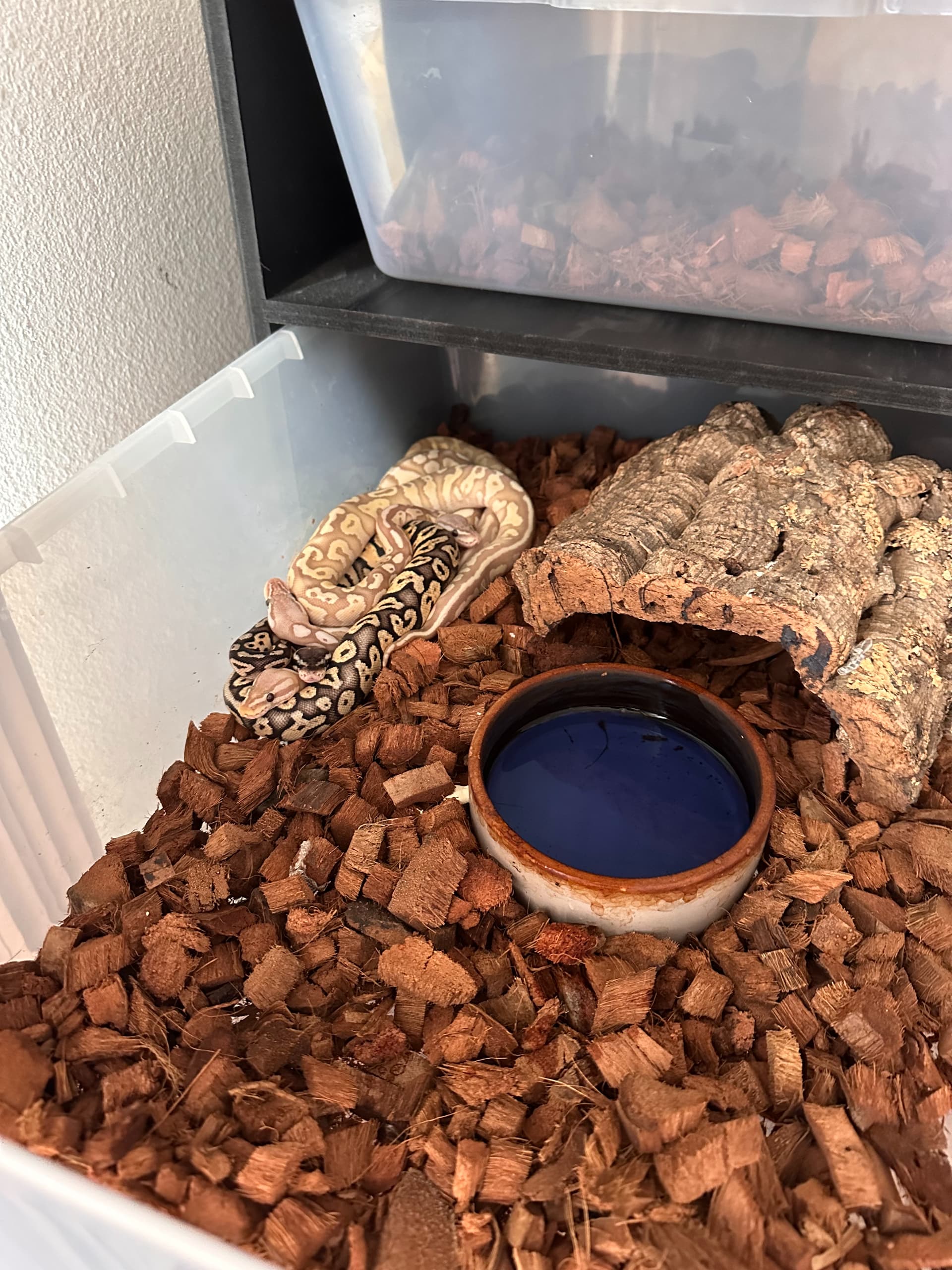
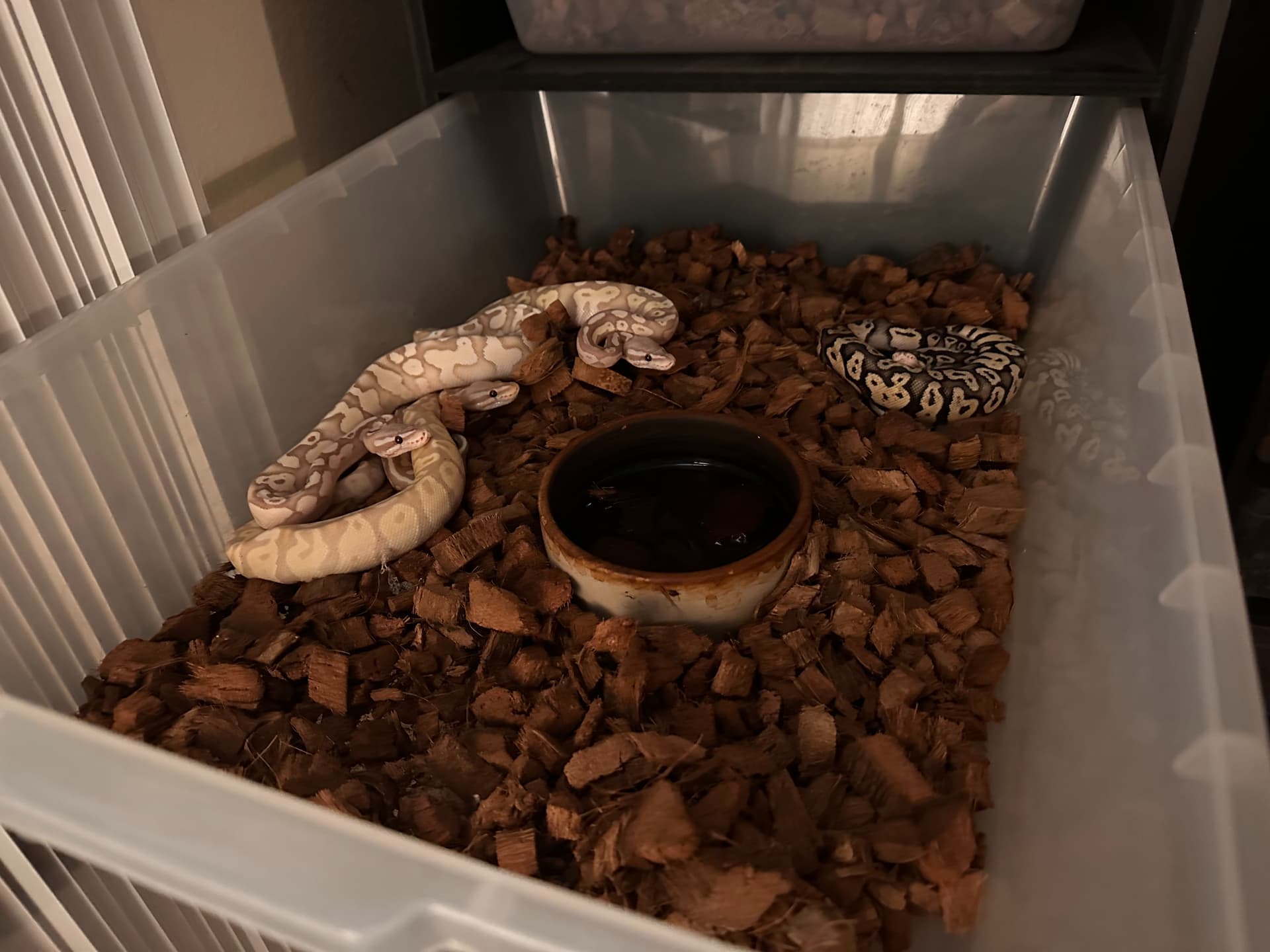
  • Heat is in the back of the rack; it’s from CSerpents. I use cork bark hides in my tubs, but I often take them out when I’m feeding or handling 'cause it makes it easier to separate the animals. Picture was from shortly after I put them back, while I’m opening the tubs around them feeding others…so you’re totally on point that they’re in alert mode. But they also weren’t afraid to be together, and the three weren’t prioritizing heat resources. Attached a pic from right now showing them much more relaxed, and I could post similar pics for days…but would that change your opinion?

  • All of my snakes, whether cohabbed or solitary, are more active prone to tracing their rack when they’re hungry. Is that not common? If it happened consistently and with my cohabbers only I would agree, but that’s really not the case.

  • When I described ‘flush against the front of tub,’ I specifically meant when they noticed fresh activity in the room. I see this as a social behavior - they have the front right corner that 2+ will pile against at once and just rest there with their heads near the top crack until an hour or so passes or I open the tub and interact with them. Two of them are more prone than the others. If I start massaging the back of one, he/she will generally slither up into my hand. The video I posted shows some of this behavior but not all; I’ll take another to make this more clear.

  • Not yet sure where I fall on separating male and female clutchmates. I am sensitive to the fact that their hormones change, and have tried to pay attention to that in my observations. I have a pair of BEL clutchmates I’ve kept together since purchase and only recently separated for breeding. They never linked with each other but immediately bred with others. In general I’ve found little sex-associated difference in habitation behavior.
11 Likes

I appreciate your willingness to explain your POV in such detail and openness!

8 Likes

I am very interested in your progress on this. I am very much a firm believer in replicating natural environment whenever it is possible and beneficial for the animals. This includes cohabitation when possible.

People are very quick to say nay to cohabitation on reptiles, but we are finding that is not always true. Even when claimed to be so. Our understanding of reptile keeping and husbandry has advanced quite a bit since these animals were introduced into the hobby. If these animals can benefit from cohabitation, and we can find a good way to set up enclosures to better ensure positive results, I want to learn about it.

5 Likes

Frankly I find this whole “dissertation” quite/too exhaustive to read, so my apologies. I am 100
percent against experimentation with/on animals. Period. End of story. Lab rats, mice, rabbits, dogs, It makes me sick. In your case I don’t see the point. PHD, thesis, curiosity ???

Placing naturally wild hungry animals in such close proximity to each other even for a short period time imo is cruel, inhumane and irresponsible for obvious reasons, in my humble opinion.

5 Likes

Agreed on this, as somebody who runs a rescue out of their house and personally knows herpetologists and other local rescuers, or even asked vets, they recommend against it and I’ve asked them all “why?” most all of them have responded, amongst family members, friends, and acquaintances, they’ve shown me plenty of situations of cohab rescues having issues with accepting resources or having major resource guarding issues, they usually show up to them incredibly stressed, underweight, unhealthy, and all around in a dying state, it can happen after the course of a couple weeks, or literal decades but almost every cohab situation I’ve seen seems to be incredibly upsetting for the snakes forced into the situation and the bystander owners having to experience it. I’ve never had ball pythons even during exploration time exert behaviors like glass surfing or trying to get out of their tubs, I’ve never had a snake display resource guarding behaviors, I have never, never ever had a snake harm another snake under my care, I think once it gets to the point where animals are harming each other and being stressed out it’s plain neglectful, that’s just my opinion on the neglectful part. Experimentation on animals I don’t think is ok either, animals are living things, and shouldn’t be put into stressful situations just to figure something new out that most likely isn’t even beneficial. I’ve also never ever had my garters act the way your pythons do and I’ve never had a wild population I keep notes on act that way, they’ve never dogpiled each other to assert dominance, they’ve never glass surfed (my captives) to get out or repeatedly try to escape, never had one think the other is food, they’re almost always doing different things unless they’re both sleeping, wether it be fishing, basking, exploring, eating, hiding, or otherwise they do it independently for the most part, true communal snakes are not communal because they truly benefit from company on its own, they benefit from being communal by being able to tolerate each others’ presence meaning more snakes in one place

7 Likes

Thank you for your response. You bring up lots of good points. :snake::+1:

3 Likes

I believe everyone is missing the point of the OP. This was an experiment and it was never stated that people should do this.
The comments that we learn from experiments is true. And in every situation we have all experimented to some level. Temps, humidity, bedding, enclosure types and sizes, and even Food types and schedules. You will find someone who will be for and against something that we all do or something that we all have done.

I am neither for or against this experiment. Having info, good or bad is not a bad thing. This is how we learn. We have all stated that this is a place to learn, share experience, give guidance, and not a place to attack. This is something we all like about MM. Some of these post read as attacks.

No Animals life was lost in this or seriously injured. There have been many other experiments that has had loss of life. An attack during feeding was stated. But I have also seen snake to snake attackes posted online by well know breeders during a posting. But no one ever made comments about them. (holding 2 snakes and one keeps biting the other while the host is talking.) now I am not saying what happened in these situations are horrible, I am just pointing out what I have seen.

15 Likes

I really, really appreciate this.

Maybe 15-20% of responses have always felt like attacks to me. This process is incredibly stressful - tbh, I’m way more concerned about getting my head bitten off by community members here than I am of incidents between my snakes.

In this thread, I think the two things I’ve noticed most are either ad hominem shots against me or selective cherry picking from the reports I give.

I’ll often read a response and be like “what!? no! that’s not what I was describing at all! My snakes don’t act that way!” But then I’ll go back and read a sentence that I wrote and be like ‘ugh…I didn’t say that quite right and it provided just enough of an opening for xyz to project this concept of ‘stress’ into my animals.’ And so I have to explain something in even more detail, because otherwise there’s an anchor to some pre-existing imagination of how snakes must feel when kept together. I don’t particularly like writing dissertations…this isn’t easy. But I try to be careful and thorough, knowing I’m stepping through a minefield of belief.

I think that tells you something that I’ve found pretty universally true - it’s hard to hold heterodox ideas. Humans tend to learn through communication and social fabric rather than evidence and data. There’s a lot of resistance to new ideas - social pressure and the need for validation dominate. It’s just how we’re wired. All of us seek social proof without even knowing it, and those who challenge an orthodox point of view are often outcast.

We also tend to have high confidence in what we think we know - and once and idea is set, particularly if it’s anchored in language (eg, ‘solitary’), we have a rigidity that’s hard to overcome even with a preponderance of evidence to the contrary.

A lot of ideas in science took decades to permeate. As an example that’s playing out right now, I’m fascinated by the Wolfram Model. I’d bet my life that it’s the fundamental theory of physics - for the first time we have a first-principles derivation of Einstein’s axioms that unifies relativity with quantum mechanics. Every day it serves as a more solid Rosetta Stone for all the theories we’ve built from observation. These are nuts results, yet Wolfram is called a hack from atop the Ivory Tower. Institutional physicists refuse to even work through the ideas to validate or challenge them despite the stream of confirming results that intersect perfectly with earlier experiments. I saw a Harvard physicist on Twitter say that she wouldn’t even consider an old, white, self-published billionaire…and her entire field was built upon the shoulders of his earlier work.

Just food for thought.

Experimenting on animals

Again, I think you can view all animal husbandry as the product of trial and error around weakly constructed experiments. Look at zoos - we can’t figure out how to sustain some species, and we’ve found that others have very different behaviors in captivity than in the wild. We have cases where we introduced social relations for ‘solitary’ animals with resounding success. Sometimes it’s necessary for their captive health…sometimes it just works fine and provides a better exhibit.

Keeping ball pythons alone in racks is no different, but it seems to be very limited in the variety of trials. I would claim that I feel bad for the overwhelming majority of collections that aren’t provided more ‘natural’ stimulation. But we’ve also reasoned that it works fine - they feed, breed, and don’t exhibit the observable measures of stress that we can identify to an extreme.

The same is true for my animals - if I gave you a random sample of my snakes one at a time, I think the only way you could identify the cohabs is that they’re, on average, almost surely more relaxed. That means more tongue flicking, more prone to slithering into your hand upon touch, more likely to look you in the eye, incredibly low on ‘flighty’ responses. I’ve successfully used cohabbing to tame long-fussy snakes. They feed well and breed well. I observe no meaningful difference in crepuscular activity, except that a few cohabbers will sometimes get ‘in sync’ and explore or camp a spot together. They don’t consistently separate to opposite spots in a habitat - overwhelmingly the opposite, irrespective of resources. I have one female that clearly prefers being alone, and it’s obvious. When she’s finished breeding, for instance, she makes her way to the opposite edge of the rack from her mate. I keep her alone.

“so I could tell they were getting really hungry from their persistence tracing the front of the tub”

This has been cherry picked and was poorly worded (trying to be concise), so I feel compelled to explain. Like all balls, my snakes mostly exist in pet-rock mode…with cohabs most often together as my pics show. But I tend to be home in the evenings when they’re most active, and my racks are mostly transparent so I can observe then when they’re in ‘explore mode’. Ball pythons and boas have relatively complex brains for snakes, and I notice that they can tell where their habitat opens. In my Kages terrariums, they like to explore the crack where the door slides open. In my tubs, they are more prone to exploring the front of the tubs than the back. Sometimes, as in my video, they have a specific spot where they like to camp, and I reinforce their curiosity by engaging with them or feeding them when they’re there.

It’s simply been my observation that crepuscular activity consistently ramps up proportional to fasting duration. And I can see it - snek has plenty enough brain to know food happens when front of tub opens. They aren’t running away from each other, they don’t spend excessive time active relative to solo snakes, they aren’t rubbing in a tense or hyperactive manner, or anything of the sort. That’s not what I was saying, and I think I have the capacity to tell the difference. But it is a convenient interpretation consistent with preexisting beliefs.

8 Likes

I think we’re just all a bit frustrated with you continuing for over a year to keep multiple ball pythons in a habitat that is not only small, barren of anything but a water bowl and a single heat source then trying to say “I’m doing science!”.
It’s comparable to how people kept ball pythons 25 years ago. I was told back then you can just keep them in a 20 gallon or a sweater bin with a heat pad for a long time. More modern approaches to ball python keeping involve cage sizes larger than yours for a single ball python of their size.

If these experiments were carried out in a larger and more naturalistic approach, I really don’t think you would be getting as much frustration directed at you. If you have the money you claim to have to upgrade the enclosures and keep these animals, why is this not happening?

12 Likes

You’re assuming that it’s not happening. Not only did I never say that, I acknowledged size was on my mind, agreed with the sentiment, and noted that I’d made recent investments in more terraria. What more do you want…or is it not really, deep down, about the space at all?

My animals are growing. Of course I’m updating habitats. I’m still a busy human and don’t get everything perfect all of the time. There are plenty of pics in this thread of the habitats I like to build, which take effort…and in both this and my other thread on maternal incubation I describe trialing different substrates even in racks and my preference for BioDude-quality environments.

I think it’s a totally fair question to ask what’s a reasonable size for say, 4x 12-14" growing clutchmates. Do they need 4x the space to cohab vs. industry standard for one? My sense is that’s a little overkill…given my observations on how cohabs choose to use space, I’d hazard 2.75x-3x seems fine. But there’s a valuable discussion there. And if industry standard is that they’re at the edge of fitting in a 12qt & 15" long shoebox at that size (which is roughly my understanding), I’d agree it’s beyond time to upgrade from 32qt. Hence my purchase of three 3ft x 2ft Kages.

But with my existing available setups, over the past 9 months or so, V70 felt like serious overkill, terrariums were used for larger animals, and I favored keeping the clutch together over splitting them up into separate tubs. They’ve had lots of room to stretch out or separate (the latter of which is rare for any extended time), they maximally use about 25% of the total tub space, and they’ve had a hide that they primarily use to climb on…so the insinuation that they’re somehow suffering this horrible choice also feels really off mark and rooted in preconceptions about their preferences that don’t map to my experiences.

In general, I think a constructive discussion about space feels a whole lot different than sensing it used as a vector for an ad hominem argument against the whole practice…

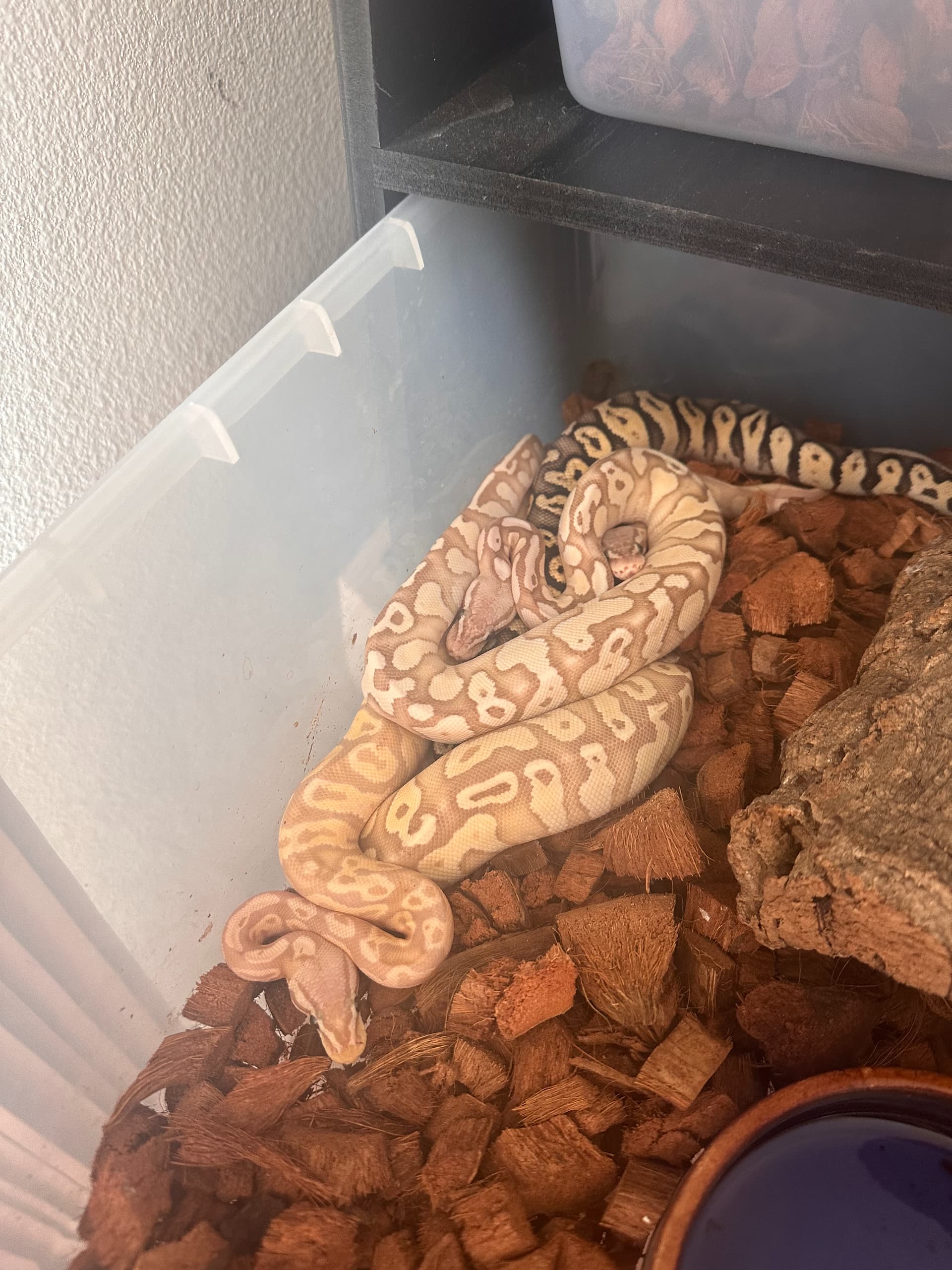
I mean, look…if I had asked this forum group to predict what would happen with cohabbing, I don’t think hardly anyone would have predicted anything remotely resembling the outcomes I’ve seen and repeated many times over (example pic below, taken right now). I’m not saying I don’t have things to learn and improve, or that I’m doing this perfect. But I am saying that when the outcome drastically diverges from naïve predictions, there are probably some really valuable things to learn that have been hidden in plain sight.

This has been pretty stressful. I’ll hang up my hat at that. There’s more than enough here for people to draw their own conclusions, and I’ll continue to work on improving the conditions for my animals as has been my goal.

6 Likes

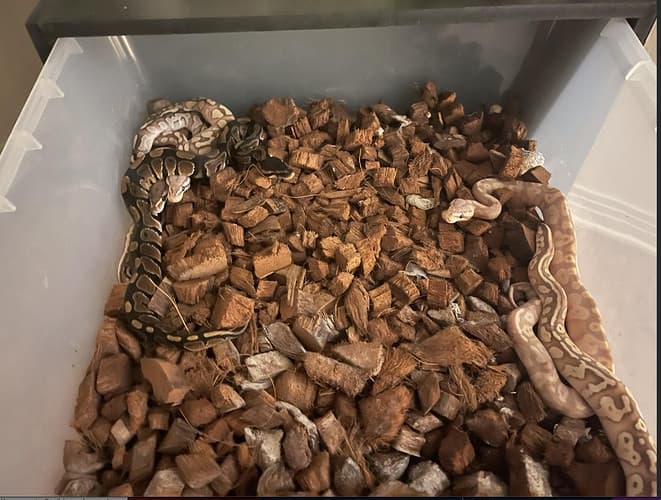
I was simply pointing out that you posted last year with the same sad setup with 5 ball python siblings then posted again with the same setup, but now only 4.
You never said what happened to the 5th? Which I assume is you rehomed it or moved it out.
But it’s the exact same barren and non-stimulating setup as before. And only after yesterday it looks like you added 1 hide? At least when you first posted, it was a more naturalistic setup,

I have co-habbed animals myself. I had a group of 1.4 leopard geckos. They were not kept to ‘industry’ standards. They were kept as usually suggested and as I have mentioned, with multiple hiding areas and multiple heat sources. They were kept in a 75 Gallon size tank vs the 10 gallon size most people used to keep a single leopard gecko in.
I’ve had to cohab different animals while working in a big box store. Every time, more care was taken to decor and stimulation than this last setup.

Every time people have tried to give you useful criticism on the enclosures it always seems to fall back to you feeling picked on or that it’s your own experiment. If anything, you’ve possibly made things worse by abandoning a setup like your first. That would have been more acceptable with the decor and spaces available for the little ones to explore while not having a much larger snake involved.

Honestly, these photos look like they could have been taken a day apart.


image

8 Likes

@wesjohnson87 So I suppose I owe you an apology for being so harsh in my post. You have spent a lot of time and effort on this project so it must mean s lot to you for whatever reason. You have obviously done tons of research and your detailed posts are proof of that.

To me, unless you are able to get inside the brain of a BP who knows what they want? Pretty much anything and everything observed is up for interpretation but nothing is proven except that everyone has his/her opinions/criticisms etc. At the end of the day what matters is that you seem to enjoy what you are doing and as long as no animal is harmed in the process then so be it.

Regards

Caron Ludan

6 Likes

Ok, I see. Those are different clutches from the same pairing (lesser+pastel w/ disco+enchi+banana), one year apart. Those five are now split into two habits; the largest three in a glass terrarium, and the smallest two in a 32qt. They’re the other snakes I have in mind for the new Kages (I’m kinda done with glass…heavy + humidity and heat are so much harder to control).

If I remember correctly the discussion context around that photo was whether they tended to separate to spread across heat resources, and I was trying to show an example of their use of the space. I have piles of cork bark that I got from a local reptile store and use for hides in most tubs (but not 12qt tubs 'cause I’ve felt like it doesn’t add much to the already tight space). I pull it out a lot…often if I’m separating for feeding or handling when it’s in use, or trying to show something like this with a pic. As I look around I have two hides on top of racks right now that I still need to return to tubs.

I could have prioritized more hides or maybe introduced something like toilet paper rolls if the cohabs seemed to want more personal space…but if that were the case, I think the better solution would be to just separate them. They’ve seemed satisfied, but I agree it’s a sparse setup. I’m not happy with it, and that’s a point of criticism that I really agree with and accept. In my mind it felt temporary.

Practically, I bred more hatchlings than I could manage in terrariums given my other obligations. I just found a new roommate who wants to help with the build-outs and care, which was a relief…I was about ready to hire a friend’s daughter as part-time help. I tried to make BioDude substrate work for racks, and even planted low-light plants to pair with the bark…but I couldn’t keep plants alive, the smell grew awful fast even with isopods, and the time/cost of changing that expensive substrate in racks to limit smell just made no sense. I resorted to coco husk + a cork bark hide well after I was confident that the animals felt secure together.

I don’t want to play victim…I’m happy to have tried something different and provided my experiences as a resource. But this is a heck of a hard topic to surface, and I have felt a lot of anxiety/frustration around my observations and words being misconstrued in the ways I noted earlier…it’s always felt important to respond/clarify because I think the meat of my observations could be lost to these interpretations. I think I would feel much less anxious and defensive if I was given just a little bit more credit in some of the responses…so thank you both, @armiyana & @caron.

:pray:

8 Likes

The issue here is you prioritizing cohabitation above all else. The fact that you’re prioritizing something you think they need above things we known ball pythons need (security, low stress environment, etc) is very concerning. You seem to think that all the critique are receiving is due to people’s inability to conceive that cohabitation can work, when in reality the issue is the poor husbandry that’s coming about as a result of your insistence on cohabitating. Multiple animals in a small tub with no individual hides to escape, no enrichment, the fact that this setup necessitates moving to feed (a stressful practice) is all a direct result of you trying to force cohabitation in a setup that’s not suited for it.

If you were to show a large, well-planned and thought out enclosure with plenty of resources for all animals enclosed, I doubt anyone here would be as critical. Travis and I have both noted that we think there are conditions ball pythons could be cohabitated well. But once again, this is not it.

In several of your first posts in this thread you emphasize how much you believe in the importance of providing enrichment and a naturalistic setup, but yet every time I see a new post in this thread I see more animals kept together in worse conditions, a perpetual downslide in quality of care.

At over a year of age, these are no longer hatchlings and this is no longer a short term setup.

Trying to observe intra-animal interactions in a stressful environment that’s forced isn’t how you draw conclusions. It’s the equivalent of observing multiple prisoners in a jail cell and extrapolating the interactions you see as a broad representation of how people interact in other social settings. These animals didn’t choose to live together, you are forcing them to live together. Thought experiment: If you opened up the tub before you went to bed, and then went to search for those animals when you woke up, would they all be at the same location in your house/apartment? I doubt it.

Most of your responses can be summed up as “I know this looks bad, but I see my animals and trust me, I know what’s happening”. That’s not how scientific conclusions are made nor presented. You have presented your observations to a group that has plenty of experience with the species (and does include scientists) and many of us are concerned. I think you should not be discounting that.

Furthermore, as someone who does work with animals in a research setting, this minimalistic setup wouldn’t even pass animal care standards at my institution for laboratory animals as we have standards which include how many mice are allowed to be cohabitated safely and necessitates a certain amount of space and enrichment.

15 Likes

I have read through this thread a few times since it’s been posted, and skimming through it again I’ve observed that you really advocate for these animals as complex, cognitive creatures and recognize that hobby standards are generally not sufficient for them to exhibit their natural behaviors, but, throughout this thread, animals have been shown in progressively smaller and more barren enclosures. (I do understand you have other terrariums and enclosures as well, but keep in mind you have only shown us one terrarium and the rest has been rack tubs) I believe you’ve even stated that you don’t think the size of the initial enclosure is even enough for your juveniles.
Personally, attempting to enrich reptiles socially before environmentally feels disjointed to me. I guess my question would be, does that provide an accurate picture of what’s best for this animal in captivity?

(as an aside, as a less social person if i was kept in a minimally furnished room with a handful of other people, i would probably end up seeking stimulation from them more than i would if we were able to have a whole apartment building)

Ultimately, I can tell you really care about your animals, and I know how hard it is to find time for projects (I have several geckos overdue for upgrades myself!). I do hope you make your way back to the large vivarium plans you had spoken about early in this thread.

BTW, no obligation to respond to me, I think other folks have probably voiced similar thoughts that you’ve responded to. Just interjecting my own two cents. :sweat_smile:

10 Likes

Let’s say that I got a large sandbox - something along the lines of 5ft by 5ft. Large, but small enough that they can actually find and grow accustomed to each other. Set it up with heat pads along the edges, and placed something like 20-25 hides along the walls. Multiple water bowls in a concentric circle in the middle. Put in 4 small snakes, covered it, and sampled the location of the snakes 100 times over like 2 months, at pseudo-random intervals. Maybe added a GoPro inside to stream the result.

Correct me if I’m wrong, but I suspect you’d subscribe to a hypothesis that >=3 snakes would be collected together in the same spot in something like <15% of samples. Even beyond the construction of an experiment for roaming the house, it seems to me that there are a few statements in your reply that that fundamentally imply cohabbing is subtractive rather than additive (eg. no enrichment, need to escape).

Mine is that >=3 would be in the same spot in >70% of cases - that the preference for being together is strong. I might even hazard >=2 in 90% of cases. In contrast with your base assumptions, I sense that the other snakes are a meaningful form of enrichment and that they don’t really choose to escape each other beyond relatively short roaming periods…and even those are very often paired.

That’s a huge disconnect, and I think it leads to us having incredibly different perceptions of what is good husbandry, or stressful experience, for the animals. Our base assumptions are so divergent it’s like we’re speaking totally different languages…even though I reaffirm that I still :100: agree on several significant points wrt space and enrichment. I know you think I don’t hear what you’re saying…but trust me, I have the same experience. It’s because this disconnect runs so deep.

I don’t even think we could remotely agree on the definition for ’stress’ in this context. I honestly can’t put my finger on what it describes if it isn’t expressed in things I can observe like tension, touch response, feeding, breeding, separation, etc. And my gross model for nature, which I think is overwhelmingly substantiated in scientific literature and husbandry, is one of anti-fragility…not frailty.

I totally believe that everyone here has lots of valuable insights and views, even though it feels like I’d be a lone outlier with my hypothesis here. Despite the characterization, I have absorbed a whole lot along the way…and I truly appreciate every bit of constructive discourse. I genuinely feel that a lot of my repetition has resulted from trying to tease repeated logical fallacies out of the discussion.

Fwiw, I am particularly skeptical of appeals to authority…which is the primary reason that I’ve never brought up my own published research background (years of primarily gene therapy work with mice and rats, so I’m familiar with lab animal standards defined by various institutions). If we settled with the perceptions of existing minds, civilization would collapse. :man_shrugging: :pray:

3 Likes

Imho I don’t see the point of continuing this conversation/thread because it is not accomplishing anything after a year of the same thing back and forth. It’s like the proverbial saying; Beating a dead horse.

End of story.

7 Likes

A Strange Game.
The only winning move is… not to play.
How about a nice game of chess?

6 Likes

AMEN @graysnake My sentiments exactly! :+1:

4 Likes

I think these statements from several people really show the general consensus, which I share.
I was interested and ready for your experiences back in the beginning when it was a large enclosure with several zones and space to seperate when necessary.

I will say this, I work in a rat lab (its 10000% fine to be against animal testing, and I myself agree it needs to be downsized to only necessary work on the minimal amount of animals possible, which is how it runs where I work) and this new system with the cohabbed siblings is actually more crowded than the rat cages we have. Rats are social animals so they need to be paired with a friend, but we never exceed 3 adults per cage of this size (2 adult males). BPs are (from what I’ve seen) an unconfirmed social status, where they generally exist alone but may take refuge together when needed (if I am wrong here please correct me).

Testing new procedures or ways of keeping isn’t inherently wrong (unless you do something crazy like trying to keep kingsnakes together), but when you dip below the standards for testing labs working with social animals, I do think a re-evaluation should be considered. I don’t know of any labs in my profession working on reptiles, but I do know if we at my lab had an animal-to-space ratio of this kind, we would not get IACUC animal ethics approval for our testing. Granted there are differences between mammals and reptiles, and you aren’t doing testing/anything that requires government ethics approval, but it may be something to consider.

14 Likes