I’m not requesting that a new gene be added, I’m requesting that this option be removed from boas because IMG has no super form. The snakes labeled super are not visually distinct from standard IMGs. I believe including the option is misleading to new keepers who are looking into morphs.
Appearance - Head
Not provided
Appearance - Body
Not provided
Appearance - Belly
Not provided
Appearance - Tail
Not provided
Proven lines
Not provided
Related genes
Not provided
Proven
Not provided
Unique
There are no super IMGs, the variation is the same as different shades in albino or other morphs
Problems
Not provided
History
IMG was once believed to be an incomplete dominant trait. However, a distinct super IMG was never identified. While it has not yet been proven to be dominant (i.e. 100% litter inheritance on an individual who was proven to be homozygous dominant) I believe it eventually will be.
Dominant traits also have a homozygous (“super”) form, meaning the animal carries two copies of the allele. The inheritance works the same way as an incomplete dominant super. A homozygous animal passes that allele to every offspring.
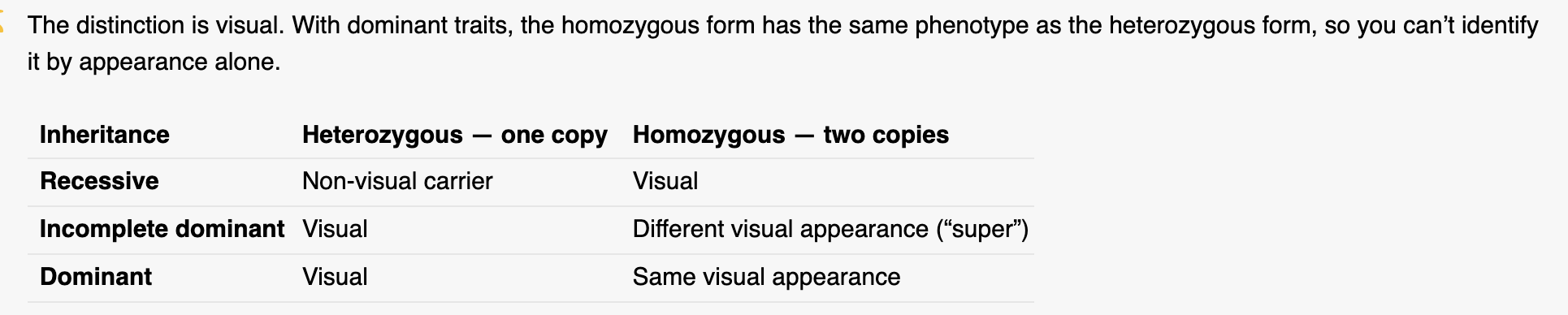
The distinction is visual. With dominant traits, the homozygous form has the same phenotype as the heterozygous form, so you can’t identify it by appearance alone.
Inheritance
Heterozygous — one copy
Homozygous — two copies
Recessive
Non-visual carrier
Visual
Incomplete dominant
Visual
Different visual appearance (“super”)
Dominant
Visual
Same visual appearance
The underlying inheritance follows the same rules. A homozygous animal passes the allele to every offspring, whether we classify the trait as recessive, incomplete dominant, or dominant.
Those labels (recessive, incomplete dominant, or dominant) describe how the allele expresses, rather than different mechanisms of inheritance.
A dominant trait therefore has a homozygous or “super” form, identically visually its heterozygous form.
This chart is telling, too, in that it uses ‘super’ to describe the visual appearance; there’s some sort of left brain/right brain thing going on, I’ll bet, where putting things into a chart overrides technical reasoning:
Isn’t there also a current belief that there are no homozygous IMGs? I suppose they probably pass pretty early in development, but I have had many breeders tell me they have tried hard for years and never once produced a whole litter of IMGs.
I get the confusion here John, but genetically a dominant gene works the same way as an incomplete dominant one… an animal can carry one copy (het) or two copies (homo). “Super” is just the term the hobby gave to the homo forms.
Would you suggest we use something like “Homo IMG” for dominant traits, and keep “Super” for incomplete dominant traits?
I’m open to starting the discussion on that, but we can’t just drop the prefix, as a homo dominant animal breeds very differently.
If we listed both as plain “IMG,” buyers couldn’t tell which one they were getting, and our calculator would give the wrong odds for offspring.
Isn’t there also a current belief that there are no homozygous IMGs?
Genetics is genetics. Every Mendelian trait has a homozygous form.
Some homos look different from the het, some look the same, some are lethal, and some can only occur in one sex… etc, but the homozygous form always exists.