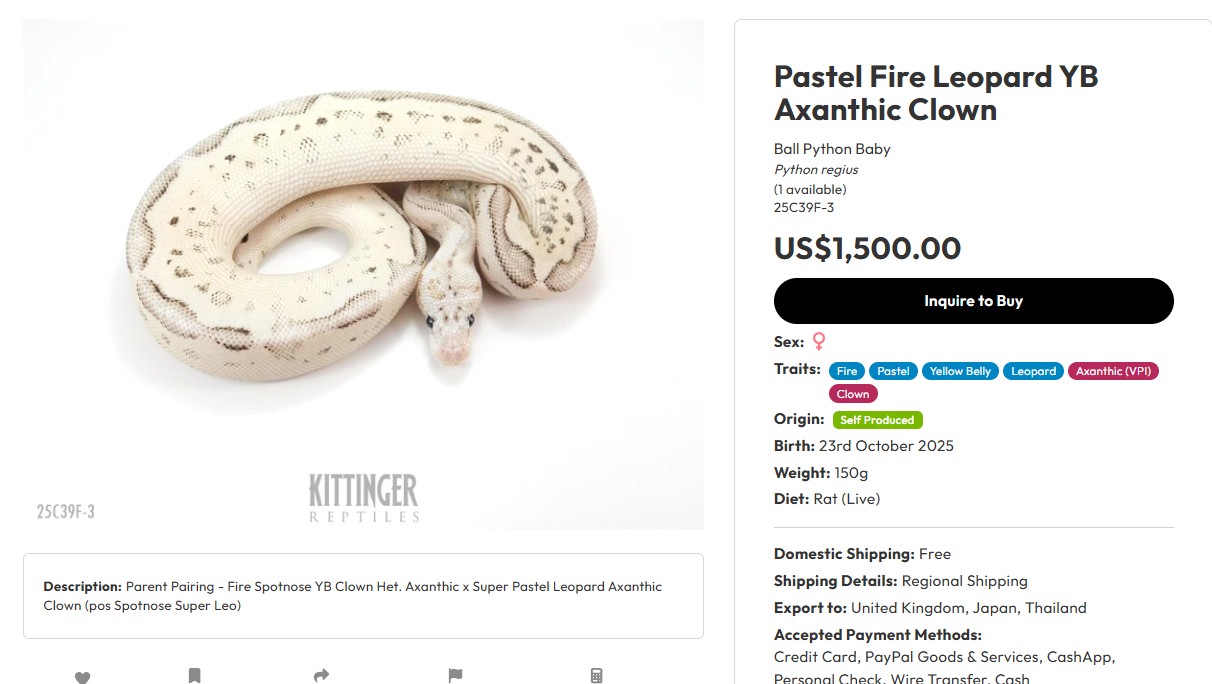
Im just trying to understand some Ball Python Genetics here and when I see a beautiful animal like this I really Cant figure out what you pair together to make something so amazing. Does both parents have to have all the traits . or does each parent have half the traits? or something else lol Genetics are confusing lol
2 Likes
I’ll try to make it simple as I can so it doesn’t sound confusing.
Axanthic (any line as far as I’m aware) and Clown are recessive genes, you can actually see so on the screenshot that they are color coded red.
Recessive means that you need a copy of the gene from both parents to produce offspring that visually show the gene.
If only one parent carries the recessive gene then you get offspring that only carry the trait genetically, not phenotypically- thats what we call “Het” or Heterozygous offpsring. In more complex terms this means that the offspring carries 2 different Alleles- one dominant allele that would result in a Normal/Wild Type appearance (if not overriden by a co-dominant or dominant morph) and the recessive allele that remains hidden in the offspring’s genetic code.
A few examples I can give is if:
A- you pair a Clown to a Clown, you will get all Clown offspring.
B- you pair a Clown to a Het Clown, you will get some Clown offspring and some Het Clown offspring.
C- you pair a Het Clown to a Het Clown, you will get some Clown offspring and some that are at a 66% chance of having Het Clown (a.k.a possible Het).
D- you pair a Clown to a Normal, you will get only Het Clown offspring.
E- you pair a Het Clown to a Normal, you will get offspring that have only a 50% chance of having Het Clown.
.
.
.
The rest of the genes (Fire, Pastel, YB and Leopard) are all co-dominant genes, color coded blue.
This means that only one parent needs to carry this gene to have visual offspring. Co-dominant genes will always present visually if the offspring end up with the gene- not all of the offspring will… unless you have a parent that carries 2 alleles of the co-dominant gene, which we refer to as a “Super” form of a morph. If a parent is a Super variant of a morph then all of their offspring will have it.
For example:
If you paired a Super Pastel to a Spotnose Leopard, no matter what all of the offspring will be Pastel.
.
.
.
In short, it took careful planning, spending a lot of $, and generations of breedings to get that BP you are looking at on MM.
I’m sure there are some who may be able to explain it better than I did, but I hope this helps you have a basic understanding of how some aspects of it work 
Edit: I missed it at first and idk if you saw it @pythonpimpin but there is the pairing information of the snake as well under the photo.
4 Likes
Thank you very much That actually helped alot
So The recessive genes are Axanthic and Clown and both parents need that.
Now because the one is Axanthic Clown and the second one is Clown Het Axanthic. That means a certain percentage of the babies will be Axanthic Clown and some will be clown Het Axanthic.
Next is the co-dominate Genes. With this Each baby has a chance of visually showing the gene . and if the parent is a super then all babies will 100% show the gene
So the parents were Fire Spotnose YB and Super Pastel Leopard
So because of the super Pastel all babies will be Pastel
then all babies have a chance to visually show Fire , Spotnose , YB and Leopard.
which makes this baby Axanthic Clown but some of his brothers and sister are Clown Het Axanthic
And this baby Visually shows Pastel and all of his brothers and sister will as well
but also it Visually shows Fire, Leopard , YB ,
and all his brothers and sister will show some combination of Fire , Leopard , YB and Spotnose.
Am I close ? lol
4 Likes
Yes, it seems you have a good basic understanding of it. Just understand that even with parents that CAN produce the exact combo you want, it can be a stretch to expect it to work. You could make the same pairing for several years and never hit what you were trying to. Where you said the siblings would be combinations of Fire, Leopard, YB and Spotnose, keep in mind the odds of getting all 4 is the same as getting none. The average baby would have 2 co-dominant genes. MM has a genetic calculator that you can play with. It will show you every single possible outcome of a paring along with the percentage chance at each one.
3 Likes
All ball python traits fall into one of three types: Dominant, Incomplete Dominant and Recessive. What makes one trait type different from another trait type is what it takes for the trait to express itself visually. The Dominant trait type is called that because it only requires one copy of the trait from one parent to express itself. Having just one copy of a trait is called heterozygous; that one copy was inherited from just one parent. Having two copies of a trait is called homozygous; one copy was inherited from the father one one from the mother. With Dominant traits, visually it doesn’t matter if the ball python is heterozygous or homozygous for the trait; visually it will express the trait. A common Dominant trait in ball pythons is the Pinstripe trait. It doesn’t matter if one copy of the Pinstripe trait was inherited from just one parent or if two copies were inherited, one from each parent, the trait will express itself visually the same The Incomplete Dominant trait type is called that because it is partially expressed visually with one copy of the trait (heterozygous) and fully expressed visually with two copies of the trait (homozygous). A common Incomplete Dominant trait in ball pythons is the Lesser trait, a lightening trait, which is “known for its rich golds, yellows, and warm browns contrasted against heavy blushing and a clean belly”. A heterozygous Lesser ball python will visually express as lighter than a normal ball python. A homozygous Letter ball python will visually express totally white, virtually no color or pattern, with blue eyes. The Recessive trait type is called that because it visually expresses with two copies of the trait (homozygous). A common Recessive trait in ball pythons is the Albino trait. A heterozygous Albino ball python will not visually express, but a homozygous Albino ball python will visually express.
Unfortunately in the ball python trade some additional terms have taken hold. Some of them are redundant and some are outright wrong. The leads to much unnecessary confusion for newbies. For example, in reference to the three trait types, many people in the trade use the term Co-dominant instead of Incomplete Dominant. They are NOT the same thing. Co-dominant is a separate fourth trait type, and there are no Co-dominant traits in the ball python trade, so far. We really need to stop calling them Co-dominant and use the proper term Incomplete Dominant. Many people use the term “het” for heterozygous, that’s an acceptable abbreviation. But they seem to exclusively use “het” in reference to Recessive traits that are inherited with just one copy of the trait. Technically heterozygous, or het, and homozygous apply to all of the three trait types. So I can handle exclusively using “het” for Recessive traits. And then there’s the term “Super”. Super is a slang term for a homozygous Incomplete Dominant trait. In reference to the example above, a ball python that inherited two copies of the Incomplete Dominant Lesser trait, one from each parent, is called a Super Lesser in the trade.
In reference to the specific ball python the OP listed, the parents have some Incomplete Dominant traits, some Recessive traits and one Dominant trait. Fire, Spotnose, Yellow Belly and Pastel are Incomplete Dominant traits. Clown and Axanthic are Recessive traits. Leopard is a Dominant trait. One parent has one copy of the Incomplete Dominant Fire, Spotnose and Yellow Belly traits. So each offspring has a 50% chance of inheriting each of those traits from the one parent. One parent has one copy of the Dominant Leopard trait. So, again, each offspring has a 50% chance of inheriting the Leopard trait. One parent is a Super Pastel, an Incomplete Dominant trait, meaning it is homozygous (two copies) for the Pastel trait. Each offspring has a 100% chance of inheriting one copy of the Pastel trait. Each parent has the Recessive Clown trait, so they are homozygous for Clown. Each offspring has a 100% chance of inheriting one copy of the Clown trait from each parent. The Axanthic trait is the interesting one. One parent is Axanthic and one is het Axanthic. So each offspring has a 100% chance of inheriting the Axanthic trait from the Axanthic parent. And each offspring has a 50% chance of inheriting the Axanthic trait from the het Axanthic parent. So to recap what can we guarantee in the offspring? They will all definitely be Pastel (but not Super Pastel) and Clown and at least het Axanthic (50% should be Axanthic and 50% should be het Axanthic). For the other Fire, Spotnose, Yellow Belly and Leopard traits, each offspring has a 50% chance of inheriting each of those four traits.
And then there are allelic traits and assorted complexes, which is kind of advanced stuff to learn after the basics are well digested.
Looks like you understand the genetics, maybe not the expected percentages, but you get the jest of it.
There are tons of ball python YouTube videos explaining this stuff too. Robert Barraclough (Royal Balls) and Green Room Pythons, in particular, do a really good job explaining ball python genetics on their YouTube channels.
2 Likes
ok I will watch those videos. Now im wondering how do you add a recessive gene to a line?
Say I have an Axanthic and I want to make it it Axanthic and clown
I would take the Axanthic and breed it to a Clown , and that would make the babies 50% Het for Axanthic and 50% Het for Clown but 0% Visual for either trait?
Then If i breed all of those babies together I would have 75% Het for Both but not Visually either of them and 25% would be Visually Both ?
And eventually if you get a boy and girl that are visually both you could then breed them to each other and the babies would be 100% both? all of them would be visually Axanthic and Clown.
Is this correct ?
No.
Axanthic x Clown
Let’s use a basic Punnett square to visualize, setting the recessive traits as lowercase. It’s helpful to be able to trace both genotypes and phenotypes.
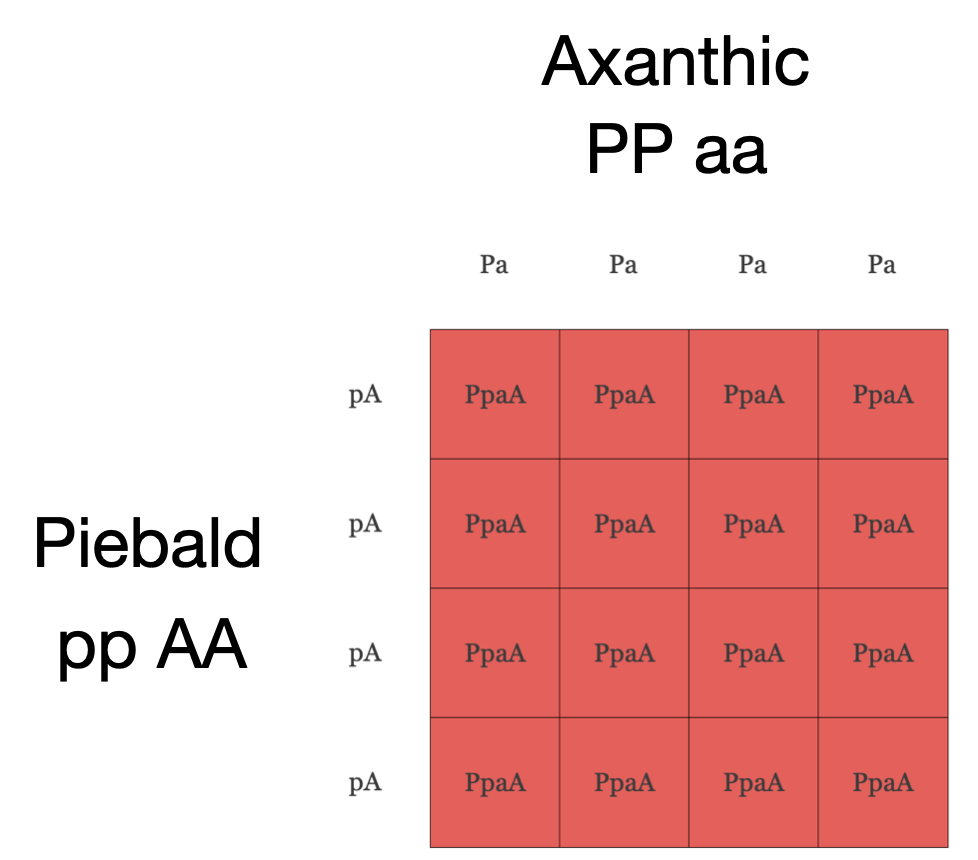
100% of the offspring will be het for both, and look visually wild type
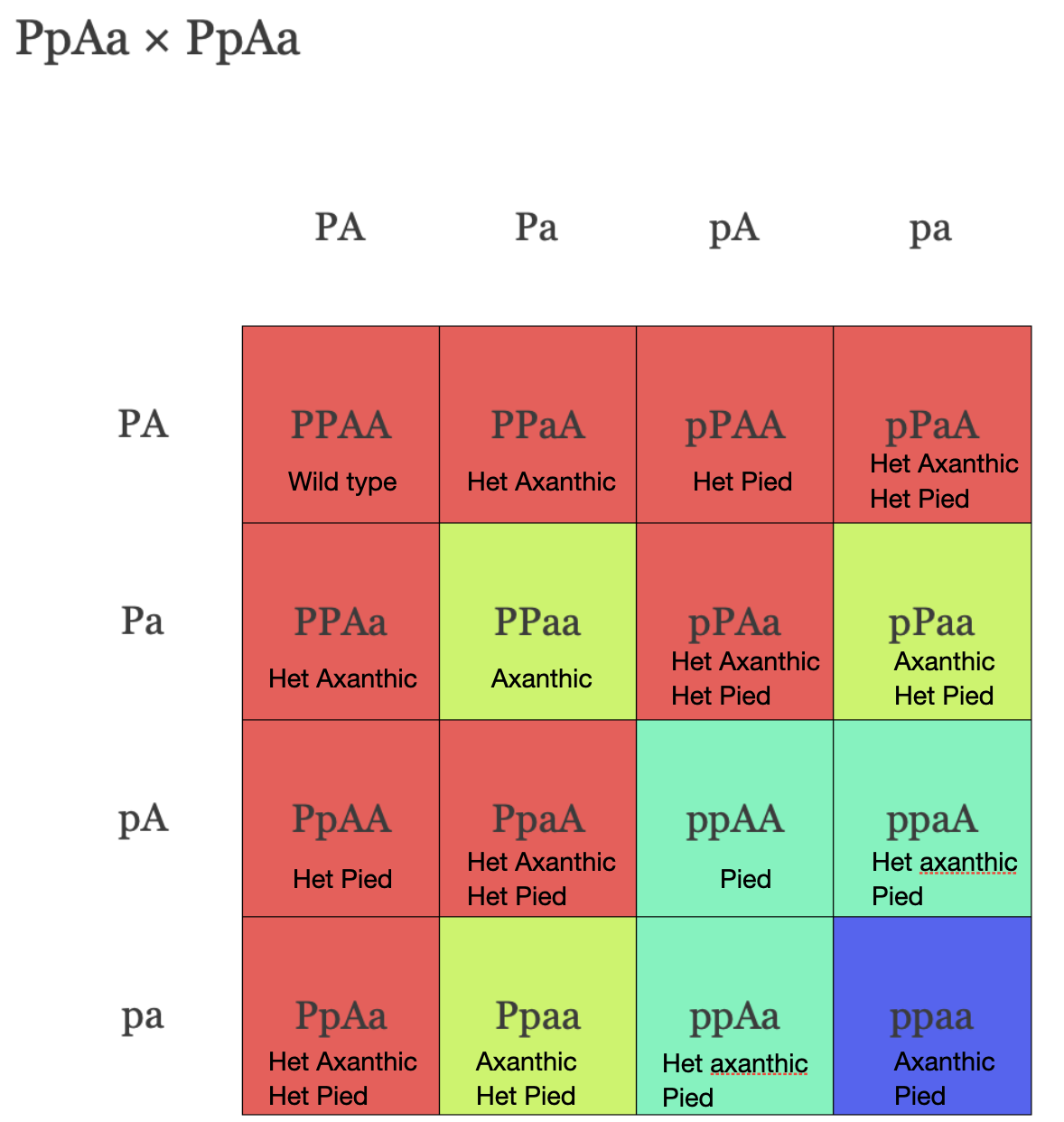
If you breed those offspring back to each other, you’ll get something like this
To simplify:
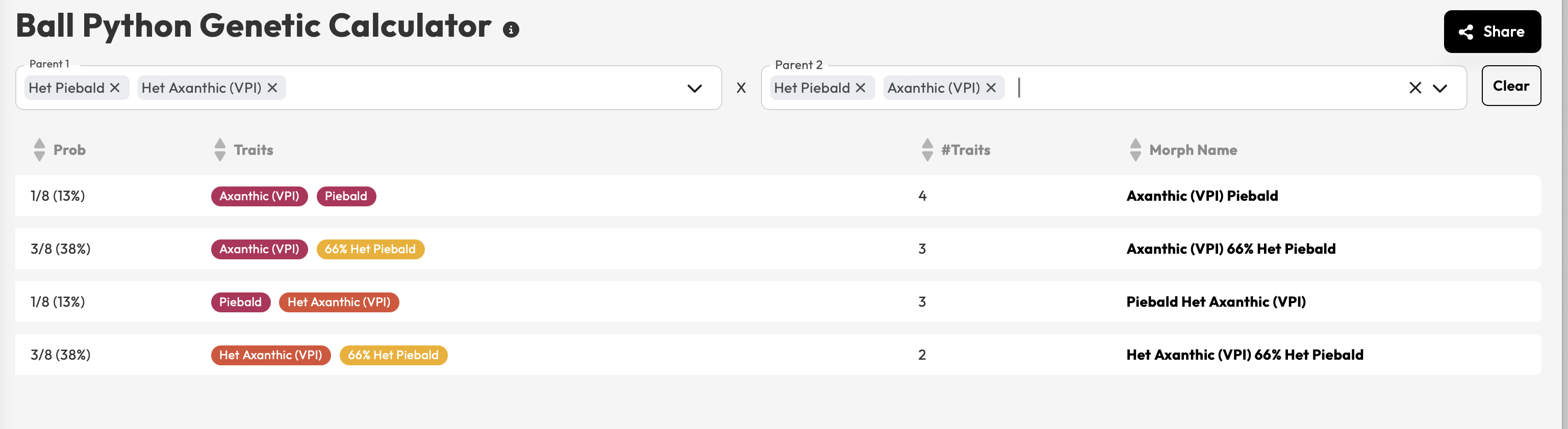
If you have a visual pied axanthic x visual pied axanthic, they will produce all visual pied axanthic babies
With the caveat for all this: Not all lines of axanthic are compatible, so if you were to buy a VPI axanthic from breeder A and a TSK axanthic from breeder B, and breed them, you will not get visual axanthics.
I would just do some reading up and practicing of basic mandelian genetics, go back to good ol’ Gregor Mendel and his pea plants. Ball python genetics is just…genetics
3 Likes
ok wow that just confused the hell outta me lol I guess i will go watch some videos on punnett squares as well lol
Thank you though i do appreciate it
Sorry, I promise I wasn’t trying to make it more confusing. It may seem like a lot at first, but once you understand why the ratios are what they are, it makes more sense
I don’t know if this helps or makes it worse. But a way I explained it to my partner and friends was the following:
When you breed you get half the info from Mom and half from Dad.
- If you have a ‘super’ dominant/incDom a visual recessive parent that have 2 copies of the gene, so one is always guaranteed to pass to the baby. 100% het
- Allelic combos/complexes are slightly different. 2 different genes act like a ‘super’ so one of the two genes always passes to one baby. They cannot pass them both to one offspring. Think BEL combos or Super stripe(yellowbelly and specter)
- A het only has one copy of the gene. So the baby has a 50% chance of getting that copy. The ones that don’t would be normal.
- If both parents are het, 1/4 of the babies are carrying both genes, so super or visual. 1/2 of them have a single gene and are het. 1/4 of them won’t have the gene at all.
The % you see for hets is also important to know. The % is the CHANCE the animal has the recessive gene.
Het to het = 66% het. That’s because out of the odds, 1/4 would be visual, 2/4 would be het and 1/4 would be normal. Out of the three, 2/3 or 66% would be het. You have a 33% chance of getting a normal.
Het to normal = 1/2 or 50% of the babies will have the gene. So you have a 50% chance of a normal.
A visual will always have a baby with the het. So 100% hets
im gonna get there. but once i Start thinking about how you would add genetics into a line it gets crazy lol
If your goal is to make an Axanthic Clown, and you’re starting with an Axanthic and a Clown, you’re at least two generations away from that Axanthic Clown. When you breed the Axanthic to the Clown, all the offspring will be double hets for Axanthic and Clown. They will look like normals, but they are indeed double hets. Grow up those offspring and breed them to each other. Each of those offspring will have a 1/16 chance of being the goal animal, an Axanthic Clown.
You can increase your odds to 1/4 and you probably only need to produce one generation if you start with an Axanthic het Clown and a Clown het Axanthic. But that starting pair will cost more than the original starting pair.
With most projects, you’re either going to spend a lot of money and get to your goal quickly, or spend a little money and get to your goal slowly. Time == Money
2 Likes