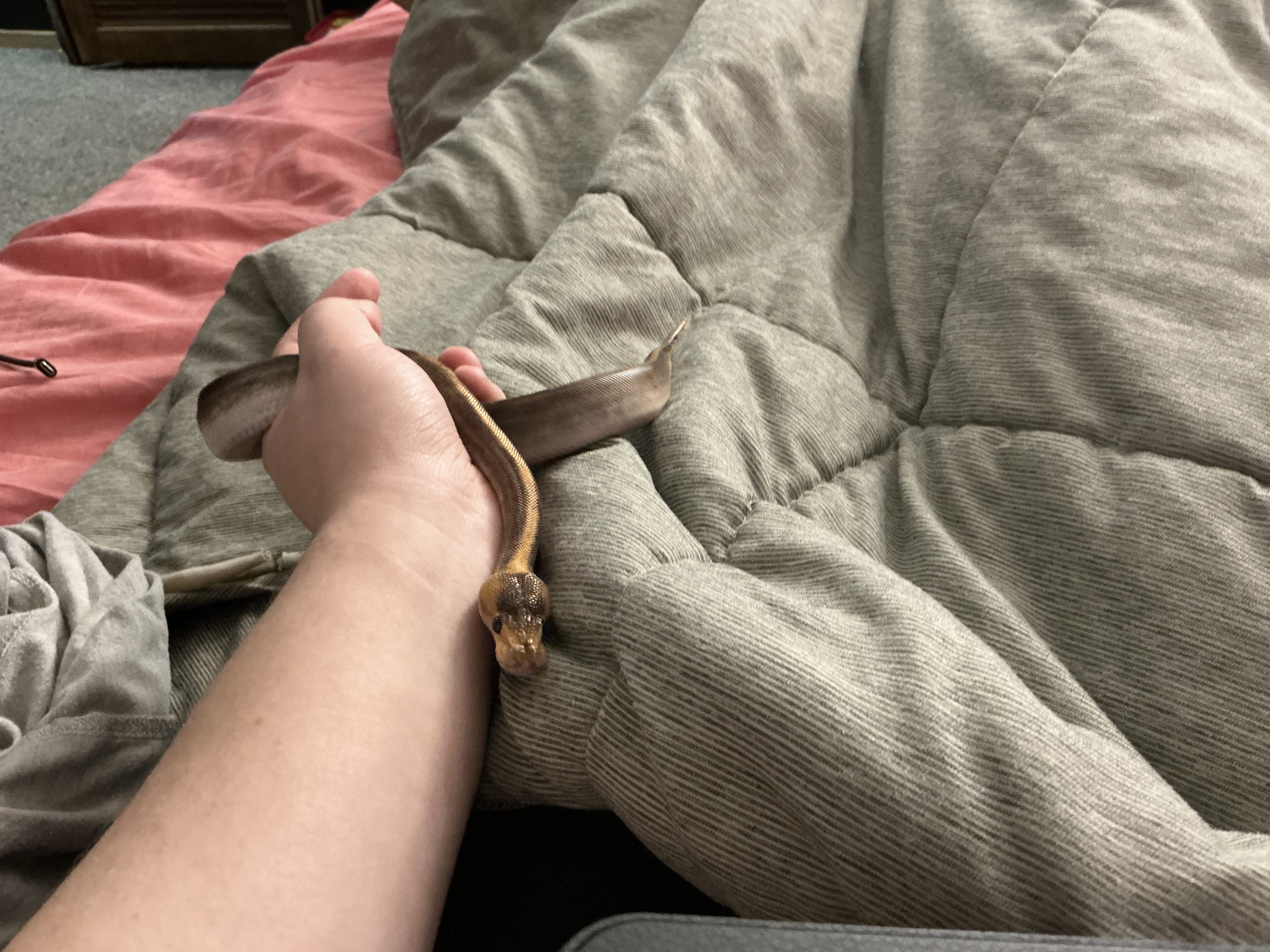
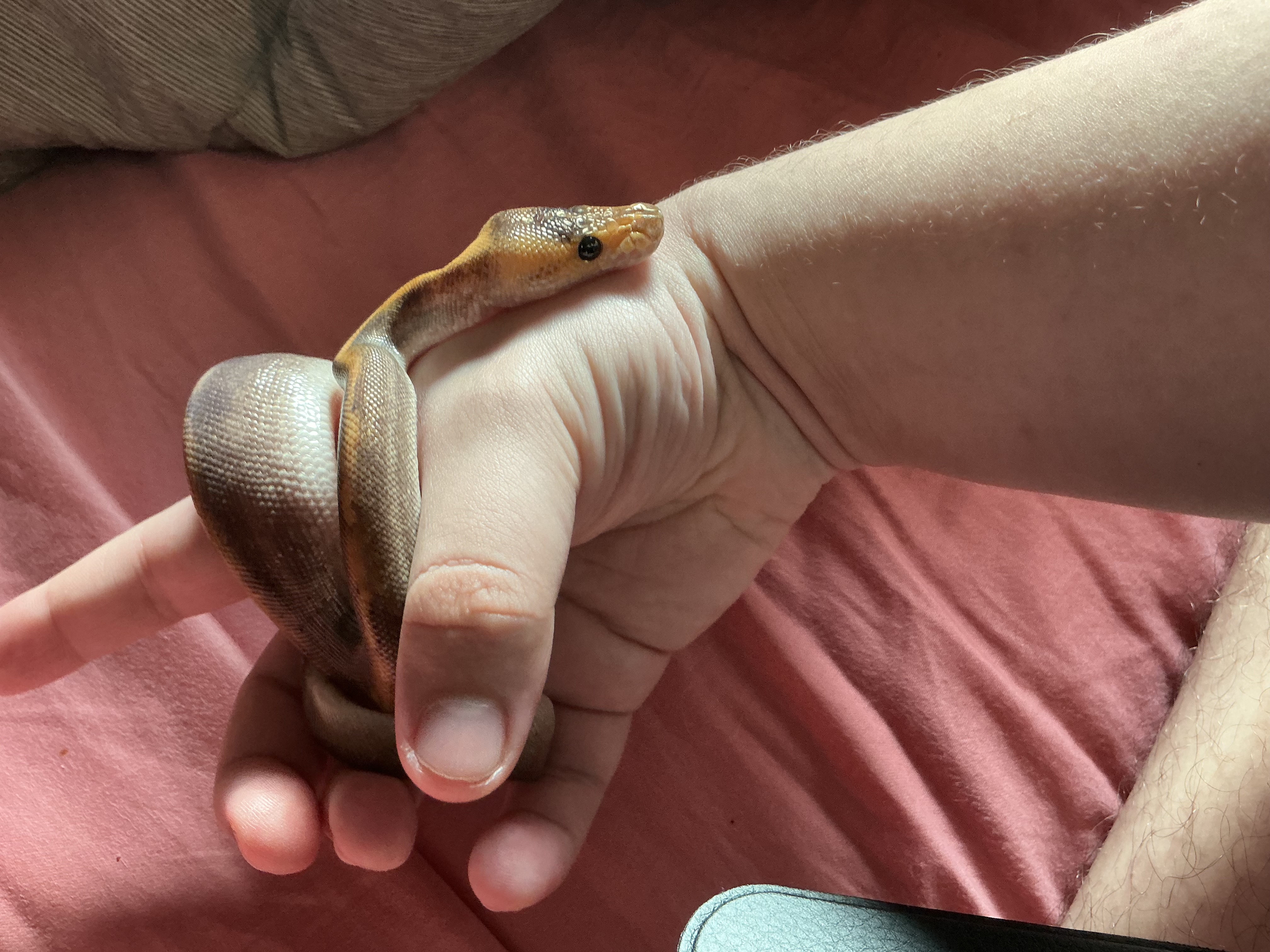
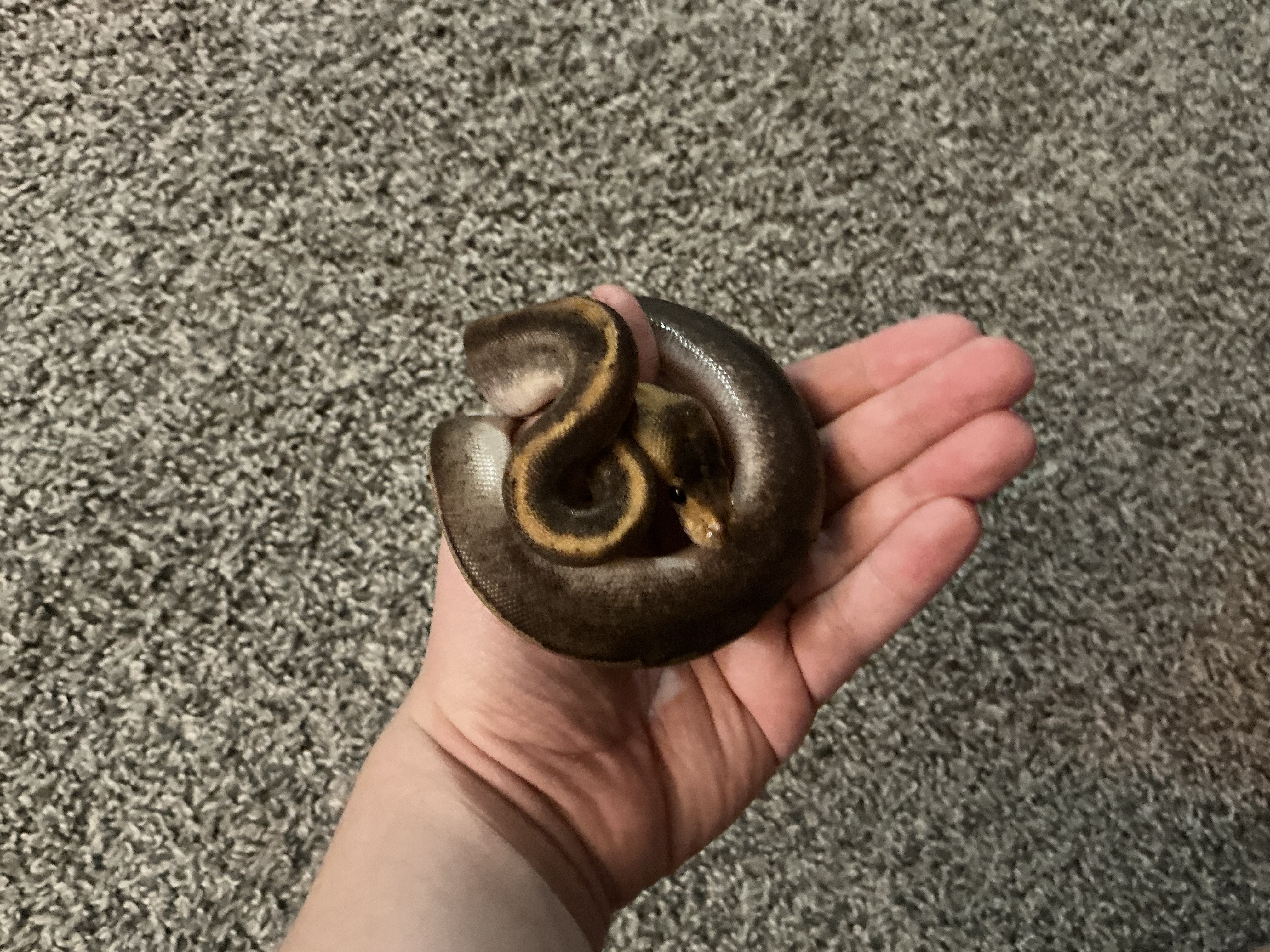
Hi! So, recently I adopted a male champagne ball python (no other genes). I’m interested in getting into designer ball python breeding in the future (as all my current bps are babies). He’s only 3 months old currently.
So, first and foremost I’m a person who is highly concerned and aware of breeding ethics with all animals as I have a lot of personal experience of the negative effects as well as myself being a person with genetic issues. The champagne morph is known for having a wobble.
That being said, from all I’ve seen it doesn’t impact them much at all- my boy (his name is Boba because of his pure black eyes) is a fantastic snake! He eats like a champ, he has a wonderful personality, and is an incredibly beautiful snake.
I have a female ball python- a super pastel enchi- who would pair very well with him. Thing is I’m not sure on the ethics of this. He has a very very mild wobble, it doesn’t effect him at all and I only notice it when he’s either stressed or when he’s finishing up a meal and needing to use his muscles to push the mouse down (again this really does not impact him at all, just something I noticed).
So, I ask the people who have more experience with ball python breeding what you guys think. I’d be happy to breed him and get more snakes as beautiful and lovely as he is, but I’d also be happy to keep him as just a pet if that’s what is best for him and any potential babies. I’ll love him the same either way, he’s a beloved member of my snake family.
So there was a very recent post on ethics for spiders recently. I would suggest reading through that for some thoughts since they are in the same allelic complex. I’ll link it at the end of my post.
The BP market is Extremely oversaturated right now. These are extremely common genes, and champagne obviously being a problematic gene. The best combo you will get is a pastel enchi champ from this pairing. This is not a fancy or designer combo if you compare it to dog breeding. This is just a mutt.
Common combos like this will be likely to just sit with you for a while and take up time, space and feeders unless you go for wholesale pricing. I recently sold a pastel cinny for 40$ as an idea of pricing for this sort of combo.
A ‘designer’ BP would be the currently trending and new combos that breeders like Kinova or Above are breeding. They are also working with the best expression of the genes they have, which can be a very long process to create because it involves line breeding, an extensive breeding project of selecting the best looking expression of the gene and breeding that to similar or better to get a consistent look.
Even then, I would not consider them ‘designer’ because the term itself is just a way breeders will try to justify that the animals they produce are a commodity. It’s a marketing strategy and should not be what you are pushing your work towards. Especially if you are trying to also consider rescue work. It’s an extremely contradictory look at things. You’re trying to find forever homes for abused or unwanted animals…but also producing MORE animals that you are calling designer like a hot new fashion.
There are a lot of things to consider before breeding. I would definitely look to study up on the genes before even attempting it. You have a couple of years to do that.
I think you misunderstand my sentiment- when I say designer breeding i mean I don’t plan to breed single gene/very common/normal snakes.
I have strong breeding ethics and wouldn’t sell to someone I wasn’t 100% sure would give the snake a good home- I feel it’s presumptuous to assume my intentions of both breeding and rescuing would be in some way contradictory. If for whatever reason a snake was unable to be sold, I’d keep them myself.
I love snakes and I don’t want anyone purchasing any snakes from me with the view of them being anything less than living, breathing, thinking animals. I still want to produce designer morphs however as I’m very interested in genetics studies and have a genuine passion for the morphs I’m going to breed for.
I’m concerned with ethics which is why I want to know more about specifically the champagne morph as while it’s in the same category as spider they do differ quite a bit in terms of severity and quality of life.
I really do want info on the champagne morph as I was unable to find relevant threads on it anywhere really- I am doing research on the gene and this is part of it, I want the views and info from people who have experience with that specific morph.
I don’t mean any of this in an overly defensive nor inflammatory way, I just mean it to clarify and make clear my own viewpoint and what I’m asking.
I don’t plan to produce a lot of ball pythons- it’s not going to be my primary breeding species and I only plan to produce a highly limited number of them, just to be clear. I just want to know what the specific implications are of the champagne morph as I specifically want to breed snakes to be friendly and very good eaters as I want to produce very good companion snakes. Quality of life is my #1 concern and is why I’m asking about this in particular
Again I mean this in a genuinely non argumentative way, clarifying again because I’m not the best at writing in tone properly so my apologies!
I do appreciate your concern and the time you took to write out a response!
I saw your other post regarding a reptile rescue within your home. Given the MM ball python saturation, breeding more ball pythons may contribute to the need for larger reptile rescue facilities……
I’m not trying to be rude here at all because I know you mean well!
By saying they’re ‘designer’ it makes it very conflicted to your rescue plans. Especially when designer has a negative connotation already when breeding animals (think backyard or milling breeders) and why are you producing more of one of the most common reptiles to show up in rescues? “Adopt don’t shop” is a common phrase for a reason.
You will really need to tiptoe around that carefully.
With the pairing you have listed, you will have single gene offspring. Everything will be pastel at the least. The all gene animal is a pastel enchi champ. That is just 3 of the most common genes available.
There’s one currently listed for sale…that has been for sale for 2 years. Can you house one ‘designer’ that long?
There are many breeders selling off their facilities right now. Because the market is so oversaturated. I just bought a rat rack from one fairly local to me.
So most of this is really just warning you of what may happen and how the public may react. It’s noble of you to want to open a rescue operation. But that alone is a very costly work already. And most of your rescues could end up being some of the genes you’re breeding.
Just as an owner and small breeder, I’ve rescued and rehomed a few animals. It is not easy. It’s even worse for the rescues…and the hardest part is knowing you can’t save everyone.
Space and time are a premium… Heck, a friend of mine just went viral for helping get a dog out of an abusive situation that police called entirely legal.
You will need a good social network to make sure you can find donors and and fosters. Or fundraising events during weekends. And that cutting into your life hours can take time away from your breeding animals or if improperly quarantined, rescues can also spread infections or parasites to your collection.
It’s a huge undertaking so focusing on one may be the best option for the best outcome.
Also… Your spotnose ball python can actually still potentially have a wobble (very rare) or at the very least some inner ear issue making them go upside down when handling. SN is part of the spider complex.
If you do breed her to your champagne as well, champagne and spotnose is a lethal combo. Just a heads up.
I’m aware spotnose and champagne are a lethal combo and I was not at all planning to pair them for that exact reason- there are unethical breeders, however I think blanket classing all breeders who breed for fancy/designer morphs as being bad is inaccurate if it’s done right.
There absolutely are ethical ways to do it- to breed for healthy, friendly snakes that eat well and have a high quality of life.
Again I really don’t plan on breeding ball pythons commercially, solely something I plan to do a few times in addition to breeding different species as my job since I don’t wanna contribute heavily to market saturation.
It’s more a matter of I love the morph combos that can be made, I love ball pythons, and would be happy to permanently keep any babies that didn’t sell as I do have the space for it.
I really do assure you that I am being as ethical and conscious of any and all issues as I can- adopt don’t shop is something I stand by, but I think independent breeders who are working to make the community a better place don’t exact count as a shop per-se.
Just my personal view on it of course and everyone is entitled to their opinions. There are a lot of breeders doing it unethically, and I strive to never be one of them no matter what- I know I’m not able to say much to prove my standards of care, ethics, etc, but I really do love and care for reptiles and the community at large around them. I want to make my presence to the community a positive one, not a negative one
The ONLY way to make a job as a breeder is to produce large number of common species in the hobby, which just further contributes to the oversaturation that is already present in the hobby
The argument of “I will make my business rare species” if a fallacy. The rare species are rare for a reason, one of which is that there are not enough people that have an interest in them. You are not going to make a business out of a species when all your potential buyers disappear after a year or two because that incredibly tiny market became saturated. Another reason they stay rare is because they are blood difficult to breed in the first place. And I am sorry to put it so bluntly, but if better people than you have tried and failed for decades, reality is that the odds are very much against you being the one that is going to crack the secret and blow the market wide open
I tried explaining all of this to you before in my post in your other thread that you basically blew off, but I will try again here. I am speaking from forty years worth of experience in the hobby. While a portion of my collection is ball pythons, more than half my collection is made up of species most people have, at best, barely even heard of. I do occasionally breed my balls, for my own silly little projects. I have not sold a single ball python in over five years. I have bred over half of my rarer species. I have not made enough money from the rare species breedings to cover my feeder costs for even a single year. That is reality. My goal was never to make money so I do not care. But you have not stopped talking about making a business and you continue to ignore the very experienced people here that are telling you that they have seen and heard everything you are saying before and every time they saw it before, it ended in failure
I think you misunderstood the “adopt don’t shop” ideology. It’s not just about avoiding buying animals from pet shops. The phrase is generally used to describe the practice/mindset of only ever acquiring animals from shelters, rescues, or re-home situations and not patronizing breeders at all. If you have purchased any of your animals from breeders, and if you intend to breed and sell your own animals, you are not living by “adopt don’t shop.”
To be clear, I don’t think that’s a bad thing. I don’t think there’s anything inherently wrong with breeding healthy animals and providing them with good care, and I don’t think there’s anything inherently wrong with purchasing from ethical breeders. I actually think that much of the “adopt don’t shop” crowd can be pretty toxic at times. Generally people apply it more to dogs and cats than livestock and exotics, but there are absolutely people who apply it to all animals. But I do think you need to know what that phrase usually means if you’re going to start a rescue. Definitely don’t tell people in the rescue community that you live by “adopt don’t shop” when you’re purchasing from breeders and breeding your own animals. It will ruffle some serious feathers, to put it lightly.
Literally never said I was gonna breed rare species nor do I plan to. Just that I’m not gonna mass produce ball pythons. I’m really not interested in saying anything more because this entire thing is non applicable to my situation, have a nice day
I don’t really tell people “adopt don’t shop” is my entire ideology (though I did mention it in this post, I just typically don’t in general)- like most things I think there’s several interpretations of how you can best abide by it and stuff and believe me when I say I’ve interacted with many highly toxic people of that ideology (enough that I know not to use it in those types of settings). I apply it to my situation by not purchasing from literal shops, others apply it to breeders too, healthy in moderation and such. I totally get what you’re saying and plan to not use that sort of terminology in the rescue circle, while I get a lot of the people who take it to a toxic degree are legitimately well intentioned I think a lot of it stems from misinterpretation of certain things (not sure if I’m phrasing that right). I appreciate the input for sure though! I absolutely agree with the sentiment. My whole goal is to not only help reptiles in need, but to produce high quality animals that are friendly, healthy, great eaters, and beautiful too. Health and temperament are my #1 priorities in the entire thing, I’m just also aware that to do it at the scale I want to I do unfortunately have to consider financials.
If your goal is high quality and healthy, then don’t work with that group. They are low quality genes and one is a wobbler.
Remember that rescues do tend to focus on wobblers as well as pastels and enchis.
Since you keep talking about the ethics of breeding, something that isn’t talked about enough is the risks involved for your snakes and that at the end of the day, it is often a selfish endeavor and not necessarily what’s best for your snakes. And I say this as someone who has bred my own clutches, and maybe will one day again down the road. I think it’s important to bring up because I often see people claiming that the reason they want to breed is because they love their snakes and that they want to be “ethical”, but there’s this weird bit of cognitive dissonance that shows up when you point out that breeding isn’t always in the best interest of your snake’s wellbeing.
Anytime you pair your snakes, there’s always a risk that male or female can be injured during the breeding process, the female could become eggbound and need expensive veterinary care or pass from complications (@inspirationexotics has some great posts about her experience with an eggbound female), and hatchlings can pass or fail to thrive. And these don’t even include any additional risks from dealing with morphs that have genetic defects.
So I think it’s really important to weigh the benefits of any breeding (is the pairing for conservation? to establish a species in captivity? to fulfill some niche or need in the reptile world? to answer some genetic or scientific question?) against the risks for your individual animals and the species as a whole (contributing to oversaturation/overpopulation).
An excellent point. I have a whole thread about a female who retained her eggs and decided never to lay them. She ended up requiring a spay surgery, which she survived, and then about six months ago she passed suddenly two years after the surgery. I’ve also had a male pass due to a breeding injury inflicted (presumably accidentally) by a female, as well as had offspring that did not thrive. Breeding can definitely come with complications and is definitely not always in the animals’ best interest. Any animal you breed, you are putting at risk of health complications. Just something to consider.
If you intend to breed and breed as ethically as you possibly can, invest in better genes, avoid pairings that produce common single genes. Focus on small scale breeding if you just want to do it for the passion of it, because if you try to breed to become something bigger as you say you want “designer Ball Pythons” you are going to exhaust yourself and your bank account doing it, you don’t get designer BPs without putting a lot of effort into it. Speak to owners of breeding businesses like Kinova and they very well might tell you the exact same thing.
The likelihood that you will keep BP offspring into adulthood is very high if you don’t end up giving them up outright. Consider if you are really willing to do that and try to run an in-home rescue at the same time. Its never going to be easy… thats the unfortunate reality.
I breed BPs myself on a small scale (about 1-2 clutches a season and that may not continue for very long at all), I don’t intend on making anything big or special out of it and its already a lot of work and $ just as it is.
I have my own special projects in the works but thats not the defining factor of what I do and I don’t expect something grand out of it. I do it because I love working with animals and I (very greatfully) have the opportunity to be able to work around emergencies and keep offspring long term- but I’ve been in the reptile hobby for 16 years and have had a long time to plan ahead for all of this.
If I were you I’d personally choose one or the other, not both breeding and running a rescue…
This might be beating a dead horse, but just to shine some light on the part that this animal is a RESCUE, which I’ve emphasized in many of my posts before and will emphasize once again. It’s totally cool if you’d like to get into breeding someday, but clearly you have some experience to go like many that are ambitious about the hobby are, keep that ambition and be willing to learn!
That being said, this animal came from a questionable past, with possible questionable lineage, with a questionable health history. This animal could’ve come from a pairing that had underlying issues, and that history was just lost with being a rescue, this animal could’ve been to the vet for five billion things you DON’T know about that make it unsuitable as a breeder.
And I would like to bring another aspect of ethics into this (unless I skimmed past it on accident, and if somebody already did, props to them!) this animal is a rescue, it deserves all the rest and as easy of a life as possible, with the stress and possible risks that come with breeding, I firmly believe absolutely no rescue or adopted animal unless it has a very closely recorded history that is overall on a good track, it should NOT be bred. It doesn’t matter how well the animal is doing now, consider them in this situation and not just what you want. Make it for the future with the right resources!