First clutch, many problems

So this was a completely unexpected clutch of 5 eggs coming from my Pewter QueenBee female to my potentially Volta Normal Male (both rescues, unknown genetics on the male as he was confirmed to have come from a breeding project involving voltas/other genetics and that was all the person knew).

But, I thoroughly believe the female has retained sperm from my (around 5 years ago) Pinstripe Pumpkin pied male (not a rescue and he unfortunately passed away very young due to internal complications which I can only believe were breeding related- I was glad to have dodged a bullet with progressing those genes forward… Until now).

My “Volta” male locked with my QueenBee unintentionally earlier in the year when I was doing a rub clean and disinfection- the QueenBee was communally raised and hates being alone when I’m doing these cleanings so I keep the two in the same plastic tub to reduce her stress. My male literally couldn’t give less of a F. And considering it was completely out of season (and the wrong temperature due to the heat waves) I didn’t think anything of it. Except he locked her for almost full 48hrs. I simply rolled my eyes, and let them get on with their business, their rubs were now fully cleaned and brand spanking new essentially so I’m glad they got it out of their system.

Discovery of the clutch was approximately 4 days after my female laid mid August (approx Aug 16th, discovered on 20th, showed no signs of being gravid, no signs of nesting behaviour prior to then). Because from one water change to another, she was literally sitting in the exact same position. Now- this is something that she tends to do but she also showed no reaction to me opening her tub nor when I changed the water (she’s very hand shy and immediately hides her head during these situations). Once, sure. Sometimes she’s feeling braver and she’ll just watch me, but twice in a row and not moving from the same spot suspicious…

Cut a long story short, my incubator ■■■■■■ up and couldn’t get up to temperature properly for almost 2 weeks (temps ranged from 27-32°C) before it packed in and magically wouldn’t go over 25°. Luckily I had an emergency setup bcs I was not happy with the fluctuating temperature. Temps ranged from 28-31°C until the first week of October. Whereupon I’ve managed to get a stable 30-32.4 the whole time.

So yes, temperature issues have extended clutch pipping and hatch dates, the initial estimate was Oct 13th+ for the top 2 eggs Vs the cooler 3 which were all around Oct 20+. One egg was already clearly dead/had stopped developing so I was expecting 4 eggs in total to pop.

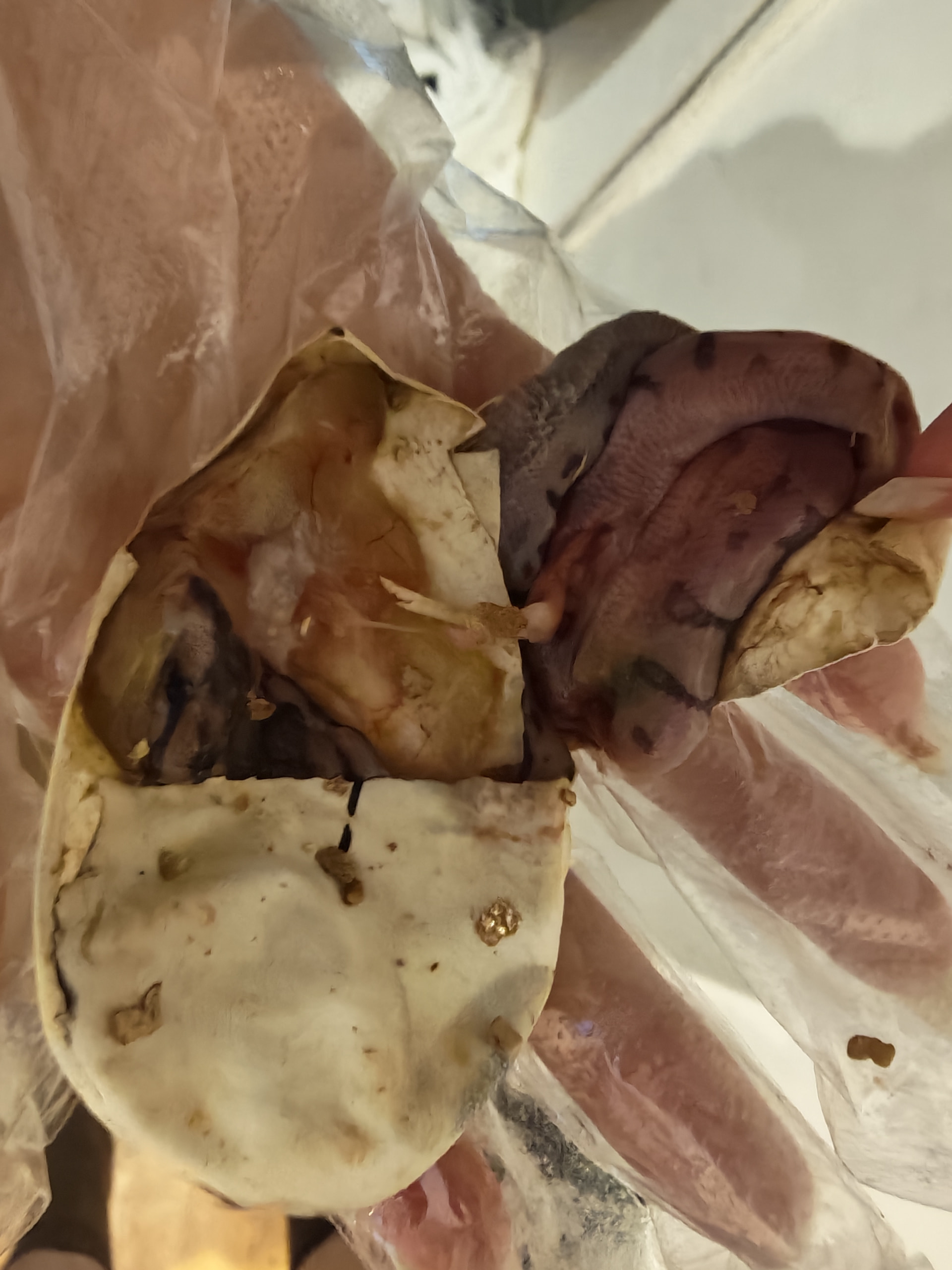
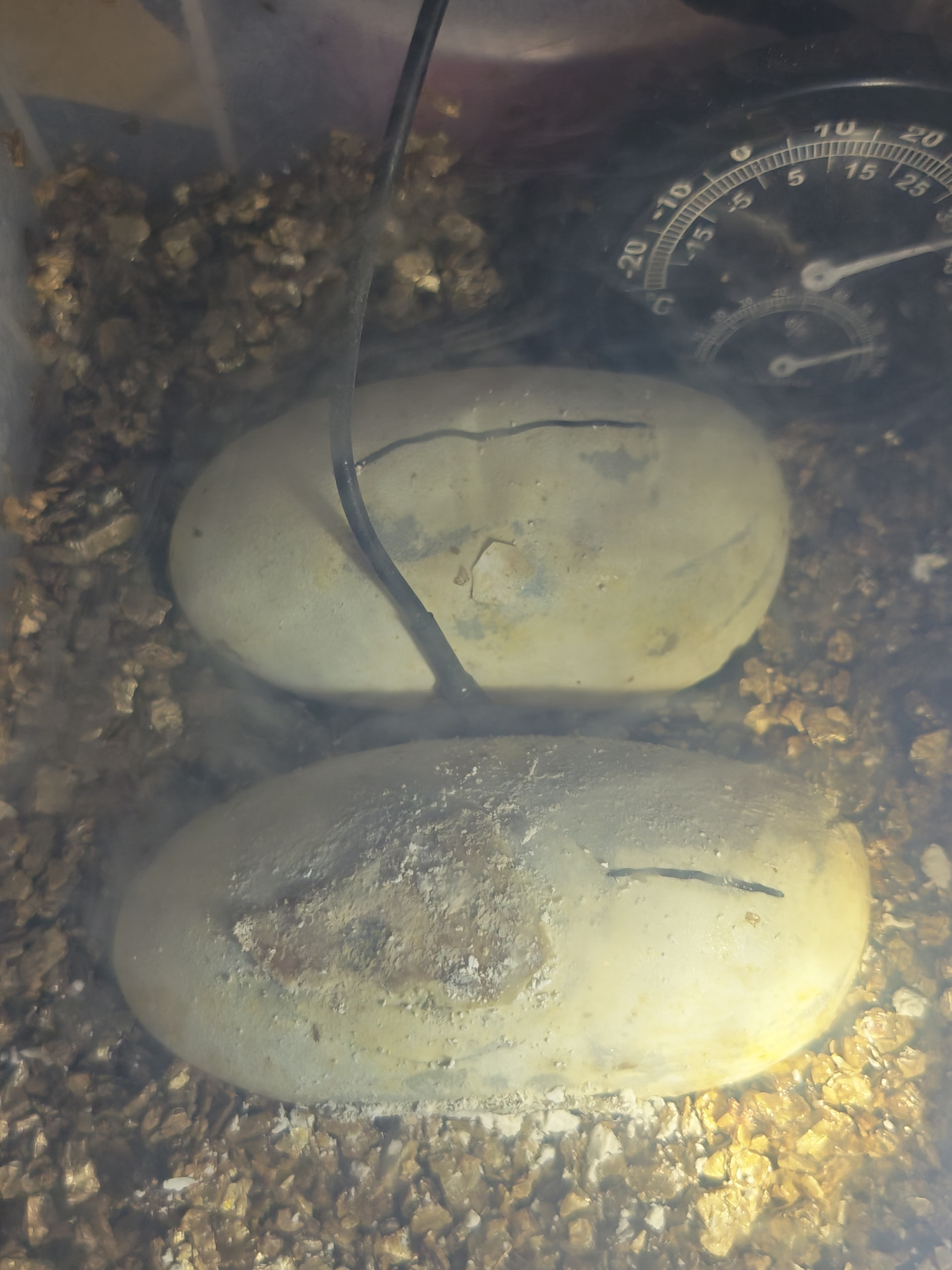
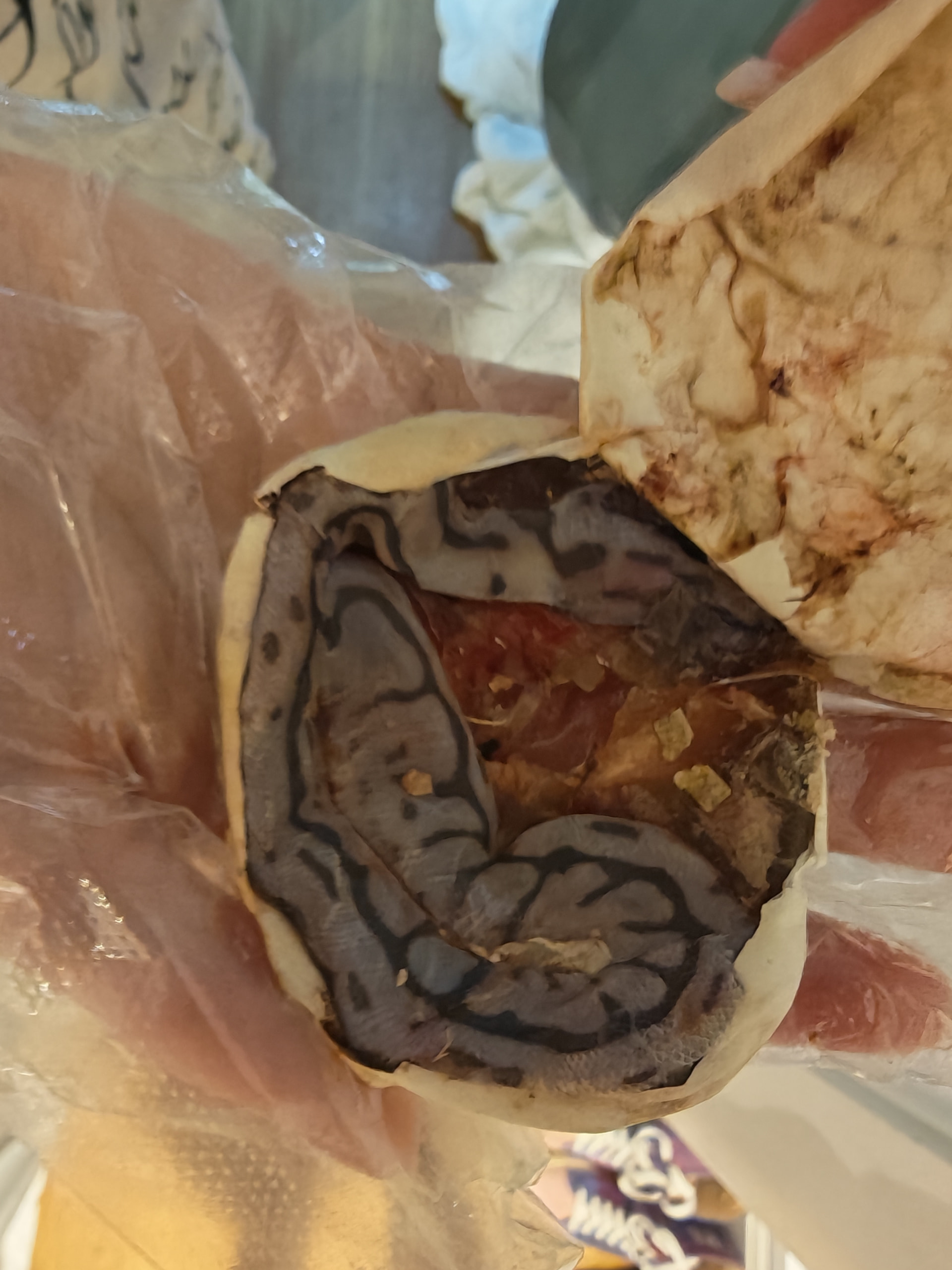
The top 2 unexpectedly died after Oct 13th for unknown reasons but I genuinely believe if I’d gone with my gut and cut slits then, the topmost egg would have survived (see photos for reference). I cut them on the 17th as I could see drastic yellowing of the shell and I feared the worst. One clearly has a set of twins were one died and I am assuming caused complications with the other breathing. Whereas there seems to be no issue with the topmost egg (single fully formed snake).

Now, this post is specifically for the bottom 2 surviving eggs and morph identification of the dead 2 (3 if were counting the twins not as one).

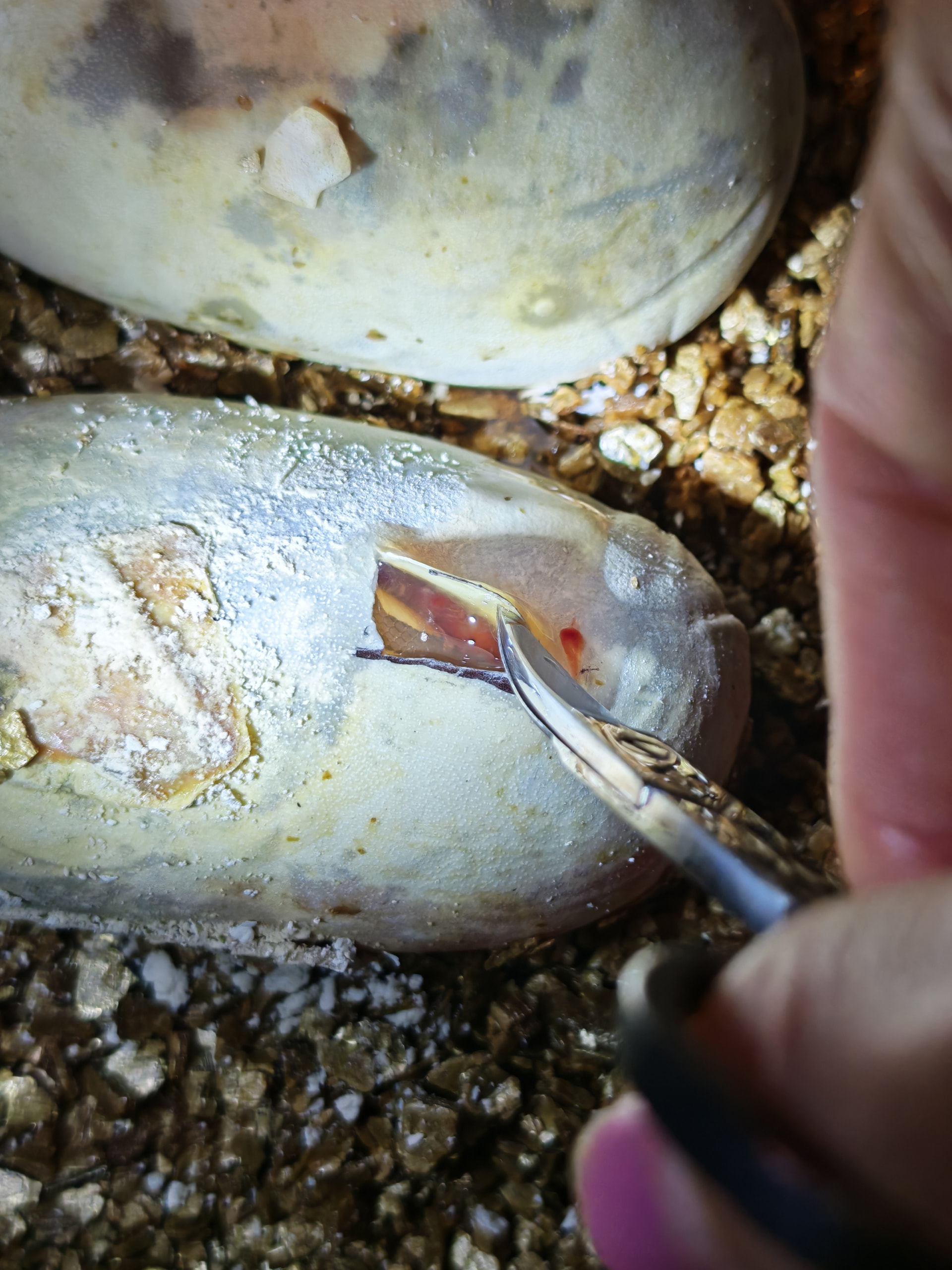
We have 2 fully formed snakes that still haven’t popped. I cut small windows on the 23rd and observed a snake that looks very similar the the topmost snake egg (single fully formed snake) in egg 2 and in egg 1 a snake that is completely different from the others and shows darker browns & yellows. No known striping or patterning at this time. Egg 1 is the one with the window image, no photos of egg 2 have been attached.

This is due to the fact egg 1 started to windowpane, wrinkle and move towards what I’d expect from an egg about a week from hatching in terms of the vesicles etc. But then it simply stopped, and now egg 2 looks far more developed (estimated to be around 24/48hrs behind egg 1 due to candling and vesicles were at a stage behind in development).

I am very concerned they still haven’t pipped or exited the eggs yet. Conservative estimates based on regular temperature logs and egg quality show they should have gone this week. I definitely need other people opinions on this. Because of this I keeping them loosely covered with a damp flannel to prevent the windows drying the remaining yolk out.

Any words of wisdom or troubleshooting would be greatly appreciated alongside the morph identification!
2 Likes

In case your wondering why I’m so convinced this is a retained sperm from previous pairing situation - the only way I can think of the single snake getting the dashed spinal patterning with the 3 head stripes, is that it inherited both pinstripe & yellow belly (something that isn’t possible from my normal “volta” boy).

While it’s hard to know exactly what went wrong here, I do think it’s a great example of why we don’t breed rescues or animals with a mystery background. You don’t know the conditions that produced these animals, any health issues in the lineages, whether they’ve been exposed to mutagens or teratogens that could impact embryo health and development, etc and you’re already dealing with a spider female that already has a defect. While I know you’ve claimed this was an “accident”, so the eggs should have been frozen and tossed when she layed.

We really should be aiming to only produce healthy, well thought out clutches. There’s so many ball pythons out there, really no shortage, so if we’re breeding and adding to the population, I think it’s important to be mindful of the quality of animals we’re producing.

7 Likes

Another factor to things is also that fluctuating temps can also lead to distortion in the patterns on reptiles as well. So some of the wackiness can also be from that.

6 Likes

Thank you for your reply that doesn’t cover any of the issues I asked about, very helpful.

But tldr- Pewter QueenBee has a known genetic lineage from breeder, surrendered due to personal reasons. Original breeding pairing was to remove spider gene. Concern over genetic issues with Pinstripe Pumpkin pied has been completely assumed on my side and technically unproven (though we could say issues with this clutch - the sudden deaths etc could be due to these but I believe they’re more likely to be from the mechanical issues exacerbating things).

And finally- there was a chance it was a retained sperm clutch, which is the only reason I kept them. I have no intention of selling the remaining two but to simply keep as my pets.

Your comments about “quality in the market” usually I would say are completely valid- but you assume far too much for such little information. Thanks for essentially saying you hope the rest of my clutch dies.

I see! I had heard sometime ago about fluctuating temperature causing visible colouring/pattern changes but I thought that was just in GTPs.

1 Like

Its not something that has been extensively studied, but there is some proof in a few species, the GTPs you mentioned and to some extent leopard geckos.
I’m sure it’s probably not nearly as common and predictable in BPs, but that may be able to explain some of the wacky patterns some carry that have never been able to be proven as inheritable.

It sounds like an all around sucky situation on your side. Hope that things work out for the last 2. I have 2 offspring from one of my favorite males that had passed away after siring a clutch.

4 Likes

I’m going to be brutally honest with my response here, but if the mods find it overboard its fine if its removed. It just needs to be said :woman_shrugging: Let this be a very important lesson.

This could have all been avoided if this was never done, the female would have been just fine if she was put in a tub by herself. What you did was horrendously irresponsible because you wanted to anthropomorphize an animal and say she needed companionship and comfort.

Ball Pythons can pair year-round. This is a widely known thing even among casual keepers. I personally do not believe this is a retained sperm clutch, 5 years is too long of a timeframe for this to occur.

This can effect incubation length even if it happened early in incubation. Its likely a part of the reason you lost some eggs as well, temperature issues can heavily damage the development of embryos early on.

I’d personally just leave the other 2 eggs be and let nature decide it’s own course of action, they’ve already been opened up and further exposed to elements when they are likely not ready to come out.

That’s not at all what @chesterhf was saying… I’ve already covered that this clutch was a result of irresponsibility, and that is essentially what Hillary said. She did not say anything about the remainder of the clutch in any way, shape or form. She only stated what should have been done in the first place. But we are here now and you have 2 eggs to look after.

30°C is fine for incubation temps, sometimes eggs just take some time, I’ve had a clutch take up to 72 days to hatch. Like I said previously, let them be and if they hatch and survive, yay! If nature decides they weren’t meant to be, its unfortunate… but if something was wrong with them its better that they didn’t hatch and suffer for days because something was wrong enough for them to be unable to thrive.

I’m also going to personally refrain from making any attempts to ID the snakes that already passed on, if you want an ID of the snake’s that are still alive but have yet to hatch, wait until after they’ve had their first shed when their colors have developed a good bit.

7 Likes

Below are words of wisdom and troubleshooting advice for the future, per your explicit request.

When keeping snakes in tubs, having extra tubs on hand is ( or should be) standard practice. The snake is removed from the soiled tub and immediately put into the previously set up clean tub. Then the soiled tub can be addressed with a minimum of upheaval for the snake.

A breeder without extra equipment at hand is operating beyond their capacity.

6 Likes

(post deleted by author)

Sorry I replied to the wrong comment there.

Hmm, I see. I did used to use a rotation system but I found it impacted when I’d remember to given them a thorough body check so I switched to; clear plastic tub, deep clean original tubs, check and wash. Place back in cleaned tubs.

I don’t think you’re overboard here but seeing as you clearly know the person who I replied to. I think you need to step back and be less biased.

Their reply provided no useful information, was based on assumptions and made it clear they did not care how this clutch turned out. Then why bother replying? I didn’t ask for opinions.

I can tell you’ve never worked with rescues- I didn’t detail her stress responses because it’s not relevant to the post but congratulations on minimising animal stress to “anthropomorphism” of an animals behaviour. Love to see that in the community… And no, I won’t clarify what they are, just know that they are serious enough to greatly impact her health if left to go on for too long.

This may also be due to her spider genetics, seeing as I’ve never seen either of my males display this behaviour at all.

As for the rest of your reply- as far as I was aware yes snakes do have breeding seasons that are temperature correlated and most modern ball pythons don’t hold to this due to the temperature controlled environments they live in. Ergo - yes they can breed year round. However, I do not keep the room they are in climate controlled and they very much experience a good level of temperature cycling, and previously (when I was actively trying to work on breeding) they followed the patterns you would expect. So excuse me for being surprised when something out of there norm happened.

Now this is based on my observed pattern of behaviour of my pets and from what I knew 4-5 years ago. I’m more than happy to be brought up to speed, but that was irrelevant to this post, and quite frankly done in an unhelpful manner.

I’m more than happy to answer questions, but I won’t be polite when someone glazes over the entire thing for assumptions and infers things.

Also retained sperm can last 5-7 years depending on the health and conditions of the animals so… The beginning of the 5 year mark isn’t ridiculous but it is a stretch to expect anything from.

I appreciate the subsequent information. It mostly just affirms what I already suspected unfortunately.

Thanks, it’s definitely something I’ll look into at a later point depending on how these two go :woman_shrugging: fingers crossed I’ll be having these two do their thing and pop out soon- then I’ll be able to get them DNA tested and figure out their genetics bless them.

So long as they’re healthy I don’t care, they won’t be going anywhere haha.

Much appreciated! They look good so… I can only hope, considering the situation I genuinely expected nothing but dud eggs. I’ve certainly learnt a thing or two from actually having a clutch that’s for sure!

Oh I’m sorry to hear that but I’m glad you got to keep something from him :heart_hands: it’s both heart breaking and nerve wracking when there’s that potential.

1 Like

People who hang out and post replies on Internet forums tend to prefer to be treated more like other human beings (who do have opinions) rather than like vending machines that just spit out whatever corresponds to the buttons that were pushed. Just FYI, I guess.

5 Likes

Hmm that’s interesting, seeing as you wouldn’t have thought a one sided over opinionated reply was what I was referring to.

Except I was and I’m fully sure you’re aware of that fact. Especially considering the context of the previous information.

Please stop replying to create some weird discourse if you have nothing of value to input here.

I’ve had a majority of my life experience working with a multitude of rescued species. Anthropomorphism is certainly an issue I see way too much in any animal community and it is harmful to animals.

Saying that your Ball Python would end up in a stressful enough situation where she needed to be put with a male or it would impact her health to be alone is a faaaar stretch, especially for such a short duration as cleaning her tub… Ball Pythons are solitary animals by nature and really only ever interact to breed, and they will if given an opportunity.

You made a mistake by allowing her to be with a male, that is your fault and you have to own it, her health and life were put at risk being bred to a male, whether or not it was intentional. You have her 2 offspring now that can live easily 30+ years, and if you can handle that, thats great! They will have a home indefinitely.

I’m sorry if that upsets you to hear the truth, but we here put our concern in any animal’s welfare over their owner’s feelings…

4 Likes

I wasn’t trying kick you while you’re down, but trying to diagnose what went wrong with this clutch does include evaluating factors like the health and background of the parents.

As someone who has been involved in rescue (taking in ball pythons as well as an established foster for two Great Dane rescues), I’m a big fan of rescuing and would never wish death on your, or any other, animals. However, there are plenty of circumstances in which we can provide loving, compassionate care for a rescue animal while acknowledging that the pairing that produced them should never have been allowed to happen. Working with rescues does require an extra level of diligence to ensure that they don’t breed, perpetuating health issues and backyard breeding. Over the years I’ve had to take precautions with my fosters/adoptees that have not yet been spayed or neutered to prevent irresponsible breedings from occurring.

Even this sounds ill thought out, as there is no “removing the spider gene”. The allele that causes the spider morph is incomplete dominant, so ~50% of offspring will inherit this allele. Breeding spider ball pythons will just produce more spider ball pythons.

I understand that you think I may be overly harsh here, but my point was that this was preventable. With careful animal management

6 Likes

Then I’m even more concerned by your reply, unless you have misread and thus misconstrued the point.

I didn’t say she would end up in a stressful situation and therefore needs to be placed with a male. I said she was raised communally (by the breeder) and does become stressed.

Again I didn’t go in to detail because it’s completely irrelevant to the post. Again I’m not detailing her stress reactions but they cause her physical harm.

Something I have literally observed mind you and again aren’t relevant to this post. Therefore they weren’t mentioned. Sure if I’d gone into detail I doubt we’d even be having this conversation.

You’re taking clearly preconceived notions and applying them here. I get it, I do. There’s certainly unethical keepers and breeders and it can be pretty rampant. But that doesn’t mean every situation outside of the norm is.

And no- it’s quite literally the opposite, I’d rather put her with a female during cleanings but I don’t have one so :woman_shrugging: the only remaining ball python quite literally has to do.

Very odd of you to say her health & life were in danger when this is the only thing I’ve found that stops and improves that very issue but go off I guess?

Sorry but I won’t be replying to you from this point on. I get what you’re saying but you’re seriously missing the mark. I do appreciate your previous input however.

Thank you I appreciate you saying that, your original reply certainly did come across pretty callously and from an overly opinionated angle without regard for the situation.

Ofcourse I am sensitive about the two remaining eggs so that is entirely my own opinion of how it came across. I’m sorry if you think my reply was agro in response to it.

I completely agree health & genetics play into this, as in a previous reply I expected these all to quite frankly to be all dud eggs but here we are. Fingers crossed everything is good with them and I can get their genetics tested.

Thank you for letting me know! As far as I was aware I didn’t realise the spider gene would hang around in the background and be carried forward (again it’s been around 5 years and I haven’t kept myself up to date with genetics). I’m glad my pet project at the time (pun not intended) didn’t end up carrying forward as it would’ve defeated the point completely!

And I get your closing point but again, not really relevant to the situation. I can only hope if these two babies do survive, one is female so going forward my QueenBee never has to be placed in the same space as a male even temporarily. Poor thing.

@deepwaters I have been following this thread but I don’t have any solid advice/input but I do want to ask why you didn’t decide to freeze/eliminate the eggs when you found them? Since they were totally unplanned. To be honest I myself didn’t realize that freezing the eggs was an option……

5 Likes