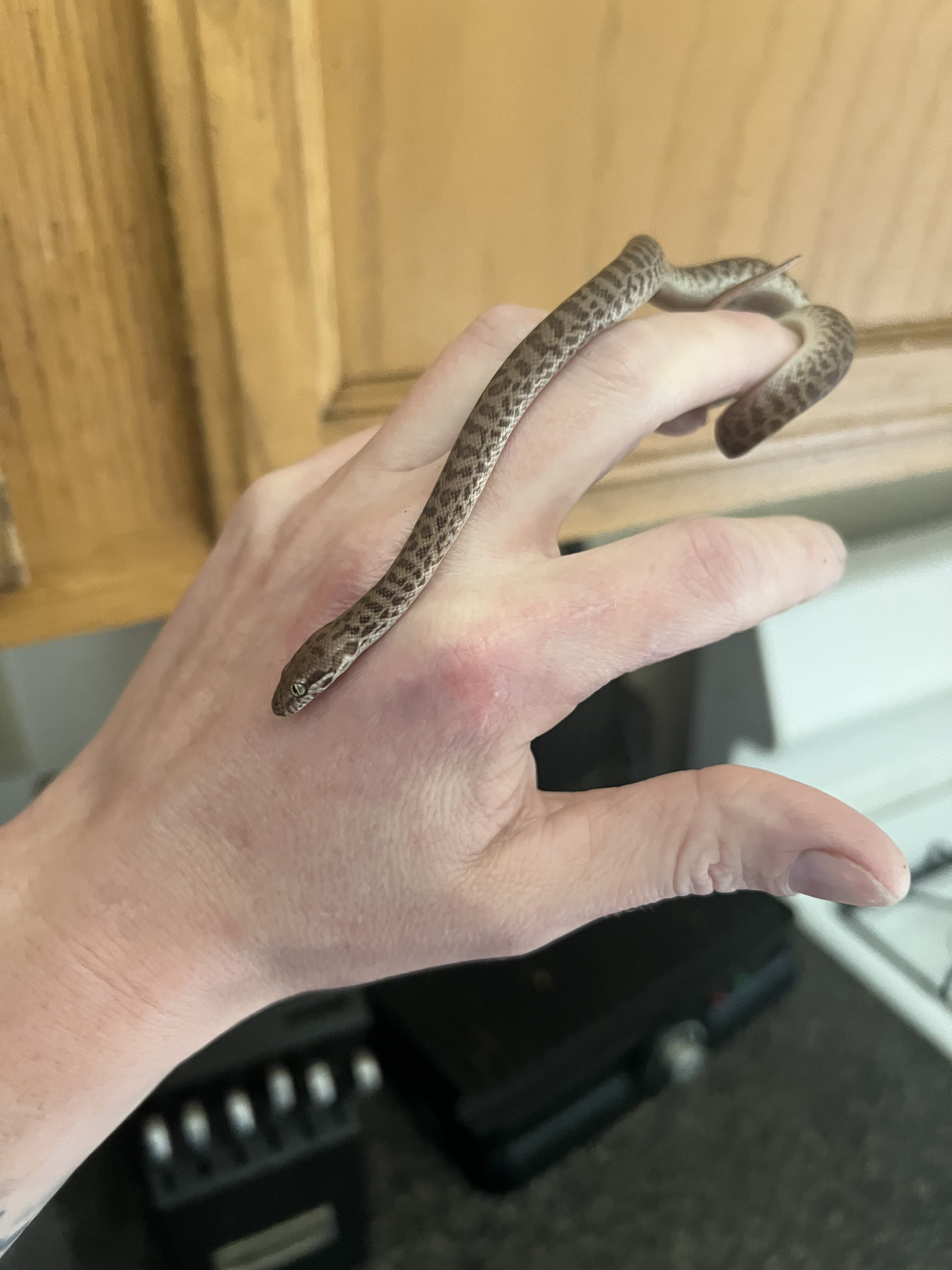
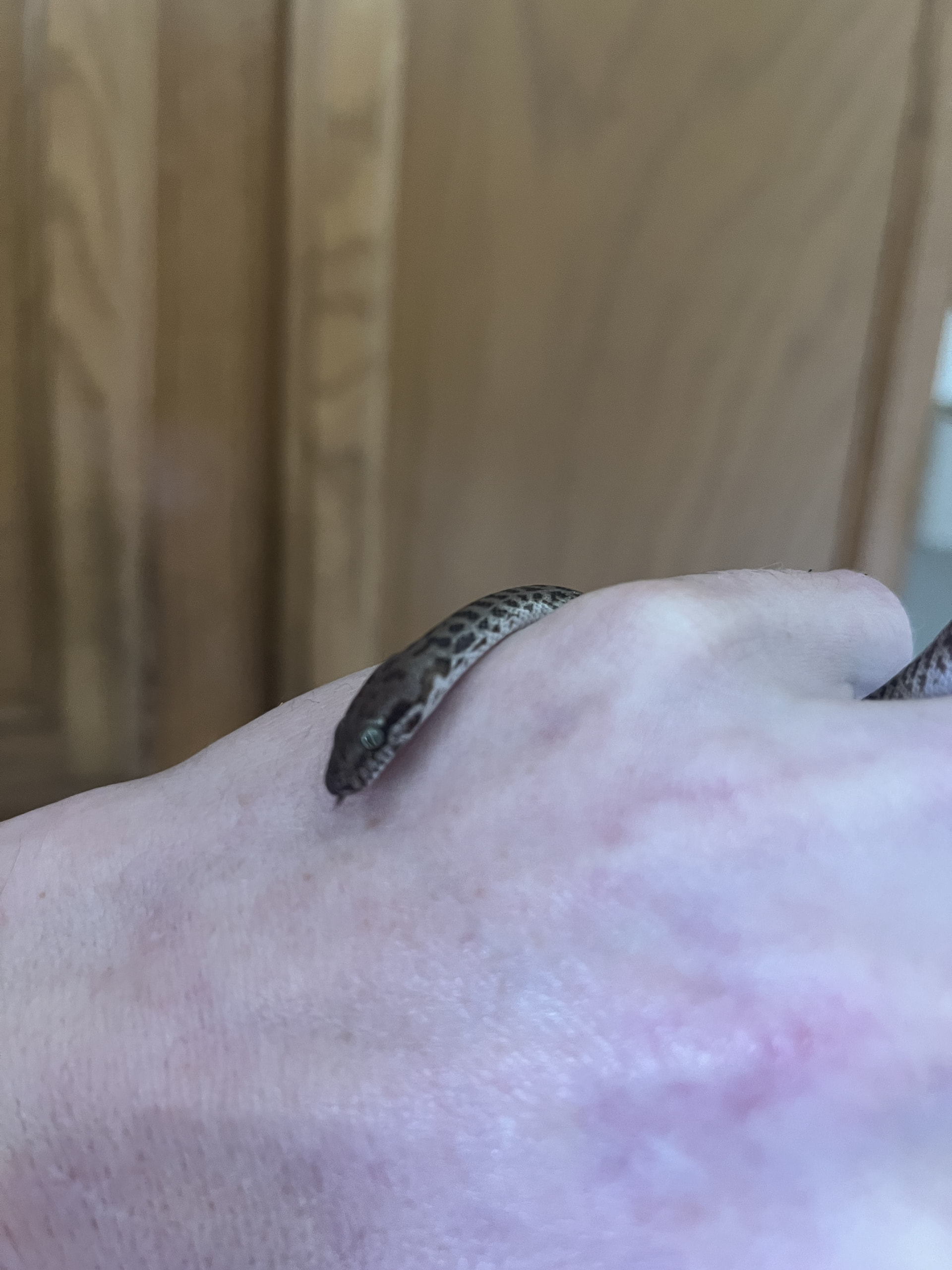
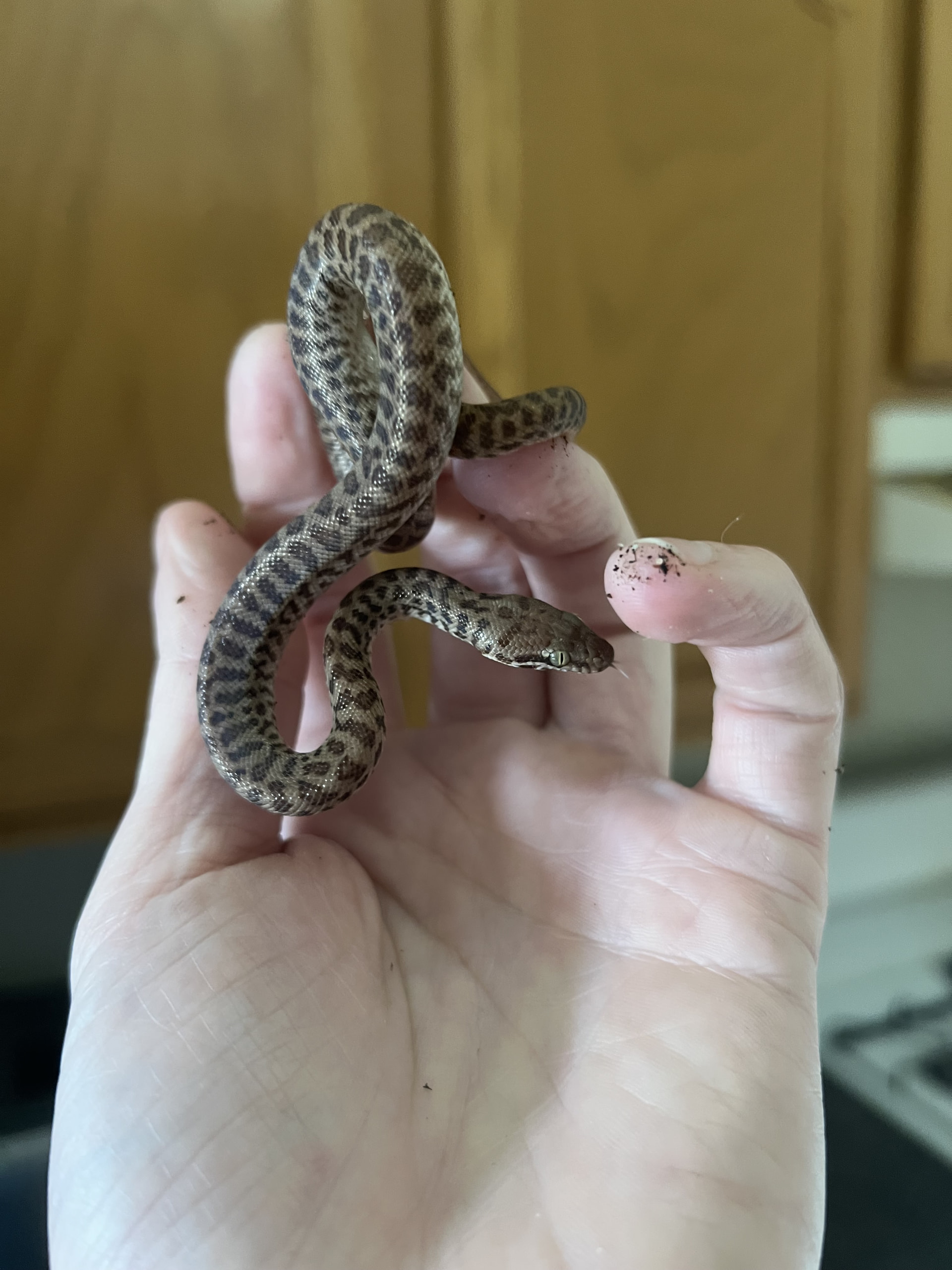
I purchased my small children’s python almost two months ago and I have yet to get it to eat. This is my first snake! Hoping I could ask if everything looks to be okay, or any tips would be appreciated.
I will provide as many pictures as I can, and answer questions as well.
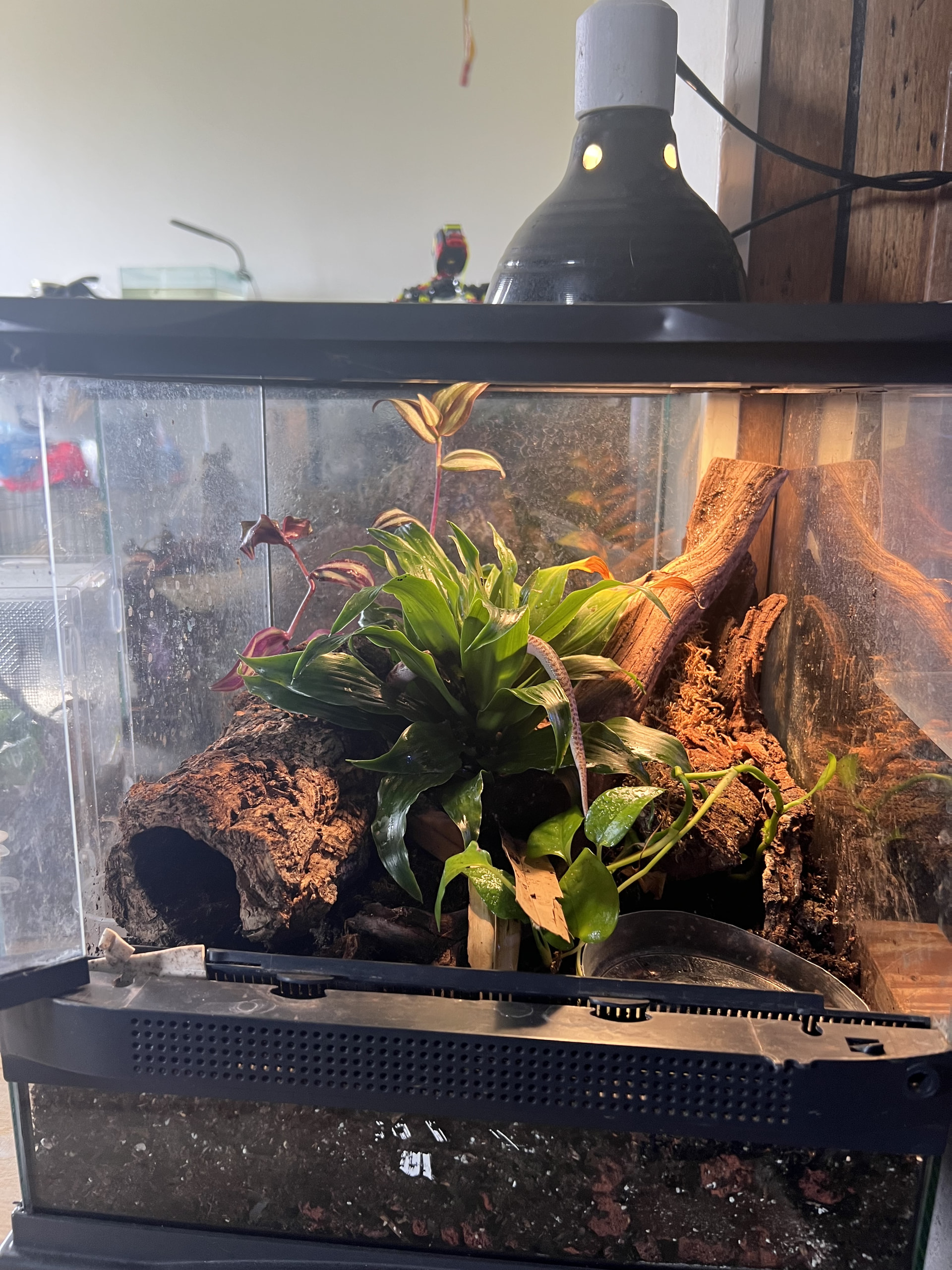
The enclosure is a 12” glass cube with mesh lid. There is a basking lamp, shallow water dish. Cork log hide along with other plants and decorations.
The snake seems to behave normally. Basking, or hiding depending on the time of day. Seems active and curious. I try to limit any handling to once a week at most. It had a full shed the first week I had it.
I attempt to feed a live pinky once a week. I started by offering it to the snake, but after rejections I now place it inside the empty water dish in hopes the snake will find it on its own time. I’ve also tried frozen/thawed pinkies I submerge in a chicken stock.
Basking area temps are low to mid 90’s. While hides or shaded areas are high 70’s to low 80’s. Lower during the nights.
I don’t have a humidity gauge, but I very lightly mist the plants in the morning. I live in a desert so most moisture is sucked up pretty quickly.
General questions for any ‘new snake, won’t eat’ situation:
Did you buy from a breeder or reseller? If the latter, troubleshooting will be much harder.
If the former: how exactly was the snake housed? What exactly was it eating? Did it get a night temp drop with the breeder? Replicating these things as closely as possible is the best way forward.
I’m not sure soaking the ft pink in chicken stock was a good idea. If it was in fact eating ft, the chicken stock may have thrown off the feeding response.
As @socraticmonologue John said, you should contact the point of sale person to find out what and how the snake was being fed before you received it.
In general, scenting is used to ‘train’ snakes that don’t naturally feed on rodents – it ‘tricks’ them into accepting a rodent, and then they learn that rodents are yummy. What’s very likely going on in this situation is not that the snake forgot that rodents are yummy.
It sounds more like the snake doesn’t want frozen thaw since it was eating live at the shop. So don’t do anything with scenting or whatever since you know it was eating.
When taking in any animal you should try to keep the diet as similar as possible for a couple weeks and change it over slowly after they’re established and eating for you.
You shouldn’t be handling them when waiting for that feeding response. That may be the key factor in why it won’t eat.
Okay, I will stop handling or trying the chicken stock
The thawed was only offered twice when the live was unavailable, so I’ll keep offering live.
The pinky is being placed in the empty water dish and just left there until it passes. Should I only put it there at night and remove in the morning? And if so, should I do that nightly until the pinky passes? The pinkies only last 3-4 days.
I suspect that temperature issues are playing a big role here. The snake can only get up to temp by being exposed, and can’t do so at all at night. Also, plants and damp dirt should be expected to lower temperatures to below ambient overnight through evaporation.
Children’s pythons iirc are ambush hunters so they don’t actively go and search for food. They wait for food to come to them. That may also contribute to things.
Have you tried offering the pinky in tongs to the snake while it’s hiding or perched somewhere?
Or has it only been leaving the pinky in a dish?
You just tried something that was not going to entice your snake to eat, as was explained by @socraticmonologue John, no matter what brand of chicken stock you used.
As @armiyana Christina said, since it was eating live you should continue with live until it eats for you and then slowly start with ft after a few meals. Also stop all handling except for maintenance cleaning and watering.
Edit to change: @mjsalye Sorry I meant to respond to your post but I responded to John my mistake. My apologies…..
I’ve tried offering it to the snake during the evening, around 8pm or so. A few times while it was in its hide, and a few times while it was perched on the top of the wood or even the inside lip of the enclosure.
The snake “flees” from the pinky, or me I suppose.
I don’t keep or breed any Australian pythons. But all the herp species that I have that thermoregulate during the day also do so at night in my care. Herps in the wild often thermoregulate at night, too, as best they can given their options. The fact that it gets cool in the wild at night isn’t necessarily a benefit to a species; it can be a serious hindrance that they need behavioral adaptations to deal with as best as possible.
When I sell a herp and the new owner reports that the animal isn’t feeding, the issue has usually been due to a couple things. Sometimes, they’re not adapting to the enclosure (too big, not enough cover/clutter/hides, or the fact that it’s a glass enclosure and all the predators are looking in), and in these cases improving their enclosure gets them feeding again.
Most often the non-feeding is due to a temp issue – too cool overall (warm side too cool, or cool side too cool, or both); inadequate options for the animal to thermoregulate and maintain their “feelings” of security while doing so; sometimes eliminating the night drop in temp has done the trick. The enclosure in the photos possibly has all three of these going on.
Just for completeness’s sake, I’ll mention that the other thing that sometimes is causing a non-feeding issue (with snakes) with a new owner is that the prey doesn’t taste/smell like the snake is used to, and in these cases when the new owner gets rodents from a different source the snake eats normally. If your snake is getting mice from a source that it is familiar with, this isn’t the issue you’re confronting but I thought I’d mention it for other readers.
All my experiences on this are based on situations where I have the animal very well established feeding before I sell it, though. This isn’t true in all cases where someone buys a herp and it won’t feed, of course, and may not be true of your situation.
“We feed it once a week” might mean that they got it in two weeks ago and fed it once before selling it. Heck, it might be the human version of AI hallucination (that is, sounds good and will fulfill my duties). A pet shop selling a live feeding snake is something of a red flag, too; I tend to work hard on snakes that are stuck on live prey for a year before selling them with caveats and a substantial discount for being B grade as far as feeding goes. An adult snake that only eats live can be a problem, and the breeder is the person who is best equipped to make it so that there aren’t keepers out there who have to deal with this.
Okay, I will give the enclosure more during the night as well.
I’m gonna go look for a lamp that doesn’t emit visible light.
for the day, right now the temp under basking lamp is mid 90’s, and the snake is in its hide at 80. 80 seems to be the temp of anything the snake could use as a hide. Should I try to bump that up a bit? This is roughly the mid point of the day for the heat turned on.
As far as the enclosure, I’ve seen it utilize almost everything in there as a hide. From the plants themselves, the actual cork log, under other wood etc. it is hard to imagine how I could fit anything more inside of it, not that I’m unwilling. But is that what you’re recommending as well?
Or is it also to upgrade the enclosure size? I do have another spare that’s 3ft long I think.
I’m about to go and see if the shop has live pinkies, this being the same shop I got it from and the same source of pinkies both the shop was using and I have been trying to use.
Tonight, when trying to feed, should I place the pinky in front of it and walk away for a bit? Then remove it if not eaten in an hour so?
I’ve been pretty careful not to make recommendations, but rather to point out (a) what I’ve found contributes to feeding problems in a wide range of herps, and (b) how those might be present in your situation. I don’t keep this species, so I’m hesitant to make firm recommendations.
But if this were my snake, it would be in a basic (substrate such as aspen chips, hides – warm, cool, and moist as necessary for the species – some clutter), non-glass enclosure with a suitable heat source that would allow for thermoregulation in and out of hiding. It wouldn’t be in anything that’s even bioactive-adjacent.
I would feed whatever it had been eating hopefully in the way it was being offered (on tongs? in a dish? in a deli cup with the snake?). If I only knew it was eating live pinks and had no more info, I’d first try a pink in a small dish left overnight. If that didn’t work I’d consider offering a live pink on tongs, well after lights out. If that didn’t work, I’d consider putting the live pink and the snake into a deli cup and putting that cup into the snake’s enclosure, being careful not to put it anywhere it would get too warm, and leave that overnight. I’d give the snake at least a couple days off between feeding attempts.
If a live pink is still there in the morning, I personally would dispatch it and discard it. Pinks sometimes die from starvation or hypothermia, but I’m not sure that letting that happen intentionally is entirely OK.
Do you have any deli cups or some plastic containers? If you do you might try to put the pink in a small container and put the snake in with it. That way the snake will have to notice and focus on the task at hand…..
Actually your tank is very attractive in a terrarium sort of way but imho not suitable for a small snake to start out in if it’s not eating. Snakes want food and security to eat the food safely.
I think your little guy needs to be in a secure small tub with a lid, soft aspen substrate, two hides one on cool end and one on warm end, some clutter in between and of course a water bowl and an under tank heat mat on one side. At least until you get the little one eats consistently.
But in the meantime you really should rearrange your tank, remove some stuff and put in 2 hides.